
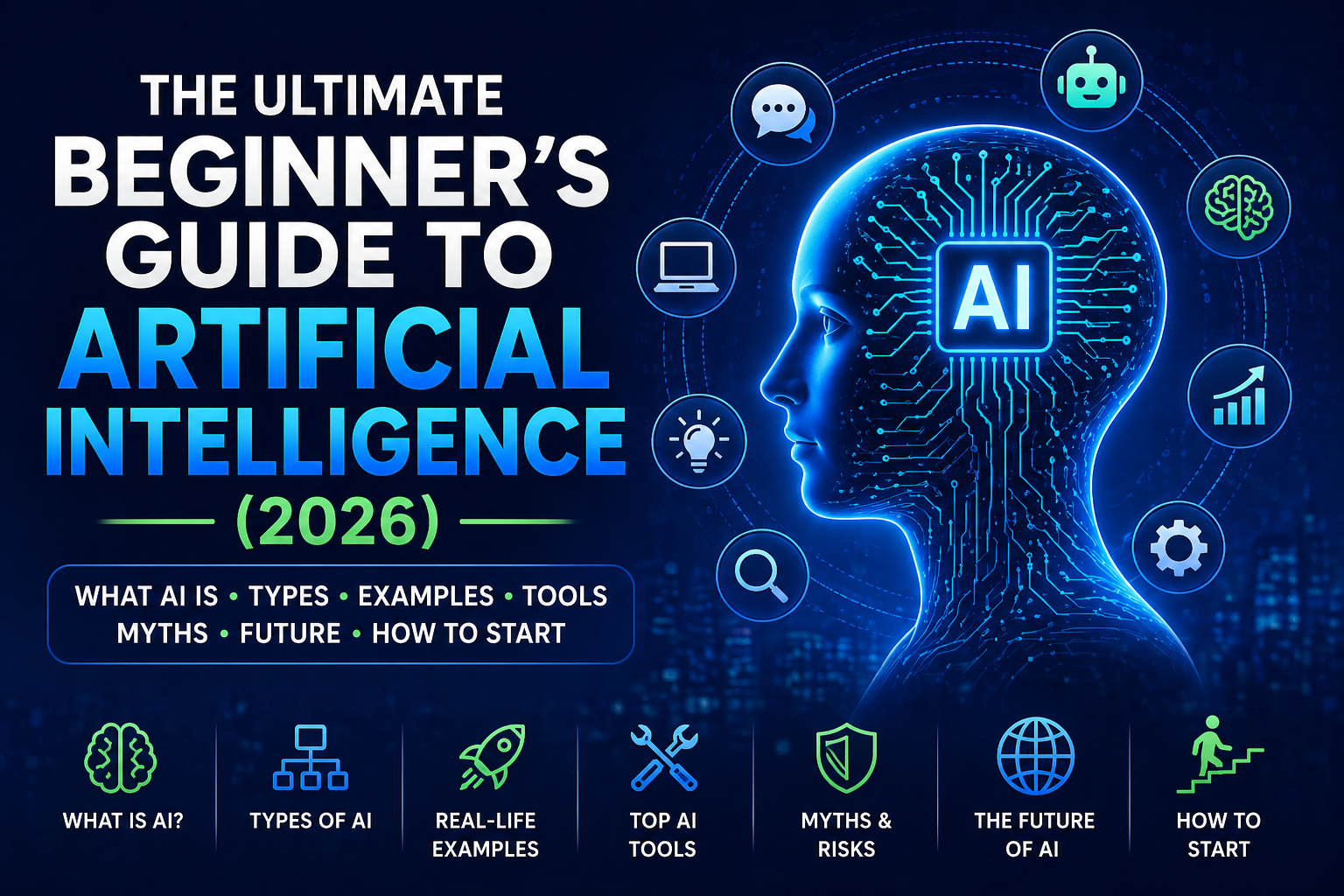
Introduction
Artificial Intelligence (AI) is no longer a futuristic concept. It is already changing how people work, create content, market businesses, and solve everyday problems.
From AI chatbots that answer customer questions to tools that generate blog posts, images, and marketing campaigns, AI is becoming a valuable business asset. Yet many beginners feel overwhelmed by technical jargon and complicated explanations.
If you have ever wondered what artificial intelligence is, how it works, and how you can start using it, this Beginner’s Guide to Artificial Intelligence will help.
In this guide, you’ll learn:
- What AI is and why it matters
- How artificial intelligence works
- Popular AI tools and applications
- Benefits and limitations of AI
- Practical ways to use AI in business and marketing
- Common mistakes beginners should avoid
- How to start using AI today
Whether you’re a blogger, marketer, entrepreneur, or small business owner, this guide will help you understand AI without the technical confusion.
What Is Artificial Intelligence?
Artificial Intelligence refers to computer systems that can perform tasks that normally require human intelligence.
These tasks include:
- Learning from data
- Understanding language
- Recognizing images
- Solving problems
- Making predictions
- Generating content
Instead of following simple instructions, AI systems analyze information and improve their performance over time.
Simple Example
When you ask ChatGPT a question and receive a detailed answer, AI processes your request, understands context, and generates a useful response.
When Netflix recommends movies based on your viewing history, AI is working behind the scenes.
When Google suggests search queries while you’re typing, AI is helping predict your intent.
AI is already integrated into many tools people use every day.
Why Artificial Intelligence Matters
AI has become one of the most important technologies in modern business.
Companies use AI to:
- Improve productivity
- Reduce costs
- Automate repetitive tasks
- Enhance customer experiences
- Analyze large amounts of data
- Create content faster
According to industry research from OpenAI, Google, and other leading technology companies, AI adoption continues to grow across marketing, customer service, finance, healthcare, and education.
Businesses that learn how to use AI effectively can gain a competitive advantage.
How Artificial Intelligence Works
At its core, AI learns from data.
The process generally follows these steps:
1. Data Collection
AI systems gather information from:
- Websites
- Documents
- Images
- Videos
- User interactions
- Databases
2. Training
The AI analyzes patterns within the data.
For example:
- An AI writing tool learns language patterns.
- An image recognition system learns visual patterns.
- A recommendation engine learns user behavior.
3. Prediction
After training, AI uses learned patterns to make decisions or predictions.
4. Continuous Improvement
Many AI systems improve as they receive more data and feedback.
Types of Artificial Intelligence
Understanding the main categories helps beginners learn AI faster.
Narrow AI
This is the most common form of AI today.
Examples include:
- ChatGPT
- Siri
- Google Assistant
- Netflix recommendations
Narrow AI performs specific tasks very well.
Generative AI
Generative AI creates new content such as:
- Articles
- Images
- Videos
- Code
- Marketing copy
Popular examples include:
- ChatGPT
- Claude
- Gemini
- Midjourney
Machine Learning
Machine Learning is a subset of AI that allows systems to learn from data without being explicitly programmed.
Examples include:
- Fraud detection
- Product recommendations
- Email spam filtering
Popular AI Tools Beginners Should Know
AI Writing Tools
These tools help create:
- Blog posts
- Product descriptions
- Social media content
- Email campaigns
Examples:
- ChatGPT
- Claude
- Gemini
AI Image Generators
These tools create images from text prompts.
Examples:
- Midjourney
- DALL-E
- Adobe Firefly
AI SEO Tools
SEO professionals use AI to:
- Find keywords
- Optimize content
- Analyze competitors
Examples:
- Ahrefs
- Semrush
- Surfer SEO
AI Marketing Tools
Marketers use AI for:
- Automation
- Audience targeting
- Campaign optimization
Examples:
- HubSpot
- Mailchimp AI
- Jasper
Practical Uses of Artificial Intelligence
Content Creation
Bloggers can use AI to:
- Generate article outlines
- Create content ideas
- Write drafts
- Improve readability
For more blogging insights, see Thinking Era Hub’s article on How to Make Money With a Blog: A Complete Beginner to Pro Guide.
Customer Support
Businesses use AI chatbots to:
- Answer FAQs
- Resolve customer issues
- Provide 24/7 support
Marketing Automation
AI can automate:
- Email sequences
- Social media scheduling
- Lead nurturing
Related reading: Automate Business Processes: A Practical Guide for Small Businesses.
Business Analytics
AI helps businesses:
- Analyze customer behavior
- Forecast trends
- Identify growth opportunities
E-commerce
Online stores use AI for:
- Product recommendations
- Inventory management
- Dynamic pricing
Step-by-Step: How Beginners Can Start Using AI
Step 1: Identify a Problem
Ask yourself:
“What repetitive task takes the most time?”
Examples:
- Writing emails
- Creating blog posts
- Customer support
- Data analysis
Step 2: Choose One AI Tool
Start simple.
Many beginners begin with:
- ChatGPT
- Claude
- Gemini
Avoid using multiple tools immediately.
Step 3: Learn Prompt Writing
AI results depend on the quality of your instructions.
Instead of:
“Write a blog.”
Use:
“Write a 1,000-word beginner-friendly blog post about email marketing for small businesses.”
Specific prompts produce better results.
Step 4: Review Outputs
Always:
- Fact-check information
- Edit content
- Add human expertise
AI should assist—not replace—your judgment.
Step 5: Build Workflows
Combine AI with your existing processes.
Example:
- Generate ideas with AI.
- Create outlines.
- Write drafts.
- Edit manually.
- Publish.
Benefits of Artificial Intelligence
Increased Productivity
AI reduces time spent on repetitive work.
Cost Savings
Businesses can automate tasks that previously required manual labor.
Better Decision-Making
AI analyzes large datasets quickly.
Scalability
Small businesses can achieve more with fewer resources.
Improved Customer Experience
AI enables faster responses and personalized interactions.
Common AI Mistakes Beginners Should Avoid
Trusting AI Without Verification
AI can occasionally produce incorrect information.
Always verify facts.
Using Vague Prompts
Poor prompts lead to poor results.
Be specific.
Ignoring Human Creativity
The best results come from combining AI efficiency with human insight.
Expecting Instant Success
AI requires experimentation and learning.
Over-Automating
Not every task should be automated.
Focus on areas where AI creates real value.
Artificial Intelligence vs Traditional Software
| Feature | Artificial Intelligence | Traditional Software | Best For |
|---|---|---|---|
| Learning Ability | Learns from data | Fixed rules | Complex tasks |
| Flexibility | High | Low | Dynamic environments |
| Automation | Advanced | Limited | Productivity |
| Content Creation | Yes | No | Marketing |
| Personalization | Strong | Basic | Customer experience |
Pros and Cons of Artificial Intelligence
Pros
- Saves time
- Increases efficiency
- Automates repetitive tasks
- Improves customer service
- Supports data-driven decisions
- Helps small businesses compete
Cons
- Learning curve
- Potential inaccuracies
- Data privacy concerns
- Subscription costs
- Requires human oversight
Cost Considerations
Free AI Options
Many tools offer free plans.
Examples include:
- ChatGPT Free
- Gemini Free
- Claude Free
These are excellent for beginners.
Paid Plans
Paid plans typically provide:
- Faster responses
- Advanced models
- Higher usage limits
- Premium features
Pricing often ranges from $20–$100+ per month depending on usage.
ROI Considerations
AI can generate significant returns when it:
- Saves employee time
- Improves conversions
- Reduces operational costs
- Increases content output
Start small and scale based on measurable results.
Who Should Use Artificial Intelligence?
Ideal Users
Bloggers
Use AI for:
- Research
- Outlines
- Content creation
Related article: AI Tools for Business: Smart Solutions for Digital Growth and Higher Profits.
Digital Marketers
Use AI for:
- SEO
- Ad copy
- Campaign optimization
Small Business Owners
Use AI for:
- Automation
- Customer support
- Reporting
Content Creators
Use AI to accelerate production workflows.
Who Should Be Cautious?
- Users expecting fully automated businesses
- Organizations with strict compliance requirements
- People unwilling to verify AI outputs
Actionable AI Tips You Can Implement Today
- Create a free ChatGPT account.
- Use AI to brainstorm content ideas.
- Generate social media captions.
- Draft marketing emails.
- Build FAQ sections for your website.
- Automate repetitive administrative tasks.
- Use AI-generated outlines before writing articles.
- Analyze customer feedback with AI tools.
Pro Tip
Spend more time improving prompts than switching tools.
Better prompts often produce better results than more expensive software.
Final Verdict
Artificial Intelligence is no longer optional for businesses that want to stay competitive.
The good news is that beginners do not need technical expertise to benefit from AI.
Start with one tool, focus on solving a real problem, and gradually expand your AI skills. Whether you’re a blogger, marketer, entrepreneur, or small business owner, AI can help you work smarter, create faster, and grow more efficiently.
The biggest advantage is not replacing people with AI.
It is empowering people to achieve more with the help of AI.
Ready to start your AI journey?
Choose one AI tool today and use it to automate a task that normally takes you hours.
Then explore more AI, SaaS, and digital growth resources at Thinking Era Hub to continue building your skills and growing your business.
Conclusion
This Beginner’s Guide to Artificial Intelligence has covered the fundamentals of AI, how it works, its benefits, common applications, and practical ways to get started.
AI is transforming business, marketing, and content creation at an incredible pace. The sooner you begin learning and experimenting, the faster you’ll discover opportunities to save time, increase productivity, and grow your online presence.
The best time to start using AI is now.
FAQ Section
1. What is artificial intelligence in simple terms?
Artificial intelligence is technology that allows computers to perform tasks that usually require human intelligence, such as learning, problem-solving, and understanding language.
2. Is artificial intelligence difficult to learn?
No. Most beginners can start using AI tools like ChatGPT within minutes. Understanding advanced AI concepts takes longer, but basic usage is straightforward.
3. What are the best AI tools for beginners?
Popular beginner-friendly AI tools include ChatGPT, Claude, Gemini, Midjourney, and Canva AI.
4. Can AI help small businesses?
Yes. AI can automate tasks, improve customer support, generate content, and provide business insights that help small businesses grow.
5. Is AI replacing human jobs?
AI is changing many jobs, but it is also creating new opportunities. People who learn how to use AI effectively are often more productive and valuable.
6. Can AI write blog posts?
Yes. AI can generate outlines, drafts, and content ideas. However, human editing and fact-checking remain important.
7. Is artificial intelligence free?
Many AI tools offer free plans. Premium plans provide additional features, higher limits, and faster performance.
8. How can I start learning AI today?
Start by using a beginner-friendly AI tool, learning prompt writing, and applying AI to everyday tasks such as content creation, research, or business automation.