

Artificial intelligence is no longer a technology reserved for large enterprises. Today, small businesses, bloggers, marketers, and entrepreneurs use AI to automate tasks, improve customer service, create content, generate leads, and increase profits.
The challenge is not whether you should use AI. The challenge is choosing the right tools from hundreds of available options.
If you’re searching for the best AI tools for business, this guide will help you find the right solutions based on your goals, budget, and business model.
You’ll learn:
- Which AI tools deliver the highest ROI
- The best platforms for marketing, content, automation, and customer support
- Pricing comparisons
- Pros and cons of each solution
- How to choose the right AI stack for your business
Whether you’re a blogger, freelancer, startup founder, or small business owner, these tools can help you work smarter and grow faster.
What Are AI Tools for Business?
AI tools for business are software platforms that use artificial intelligence to automate repetitive tasks, analyze data, create content, improve decision-making, and increase productivity.
Instead of spending hours on manual work, AI can:
- Write content
- Answer customer questions
- Generate marketing campaigns
- Analyze business data
- Create images and videos
- Automate workflows
- Improve sales processes
Businesses that adopt AI often reduce costs while increasing efficiency.
According to research from OpenAI and McKinsey & Company, AI adoption continues to accelerate because it helps companies improve productivity without significantly increasing headcount.
Why Businesses Are Investing in AI
AI delivers several advantages:
Increased Productivity
Employees spend less time on repetitive work.
Better Customer Experience
AI chatbots provide instant support 24/7.
Faster Content Creation
Marketing teams can create blogs, ads, emails, and social media posts much faster.
Improved Decision Making
AI analyzes large amounts of data quickly and identifies trends.
Lower Operating Costs
Automation reduces labor-intensive tasks and human errors.
15 Best AI Tools for Business in 2026
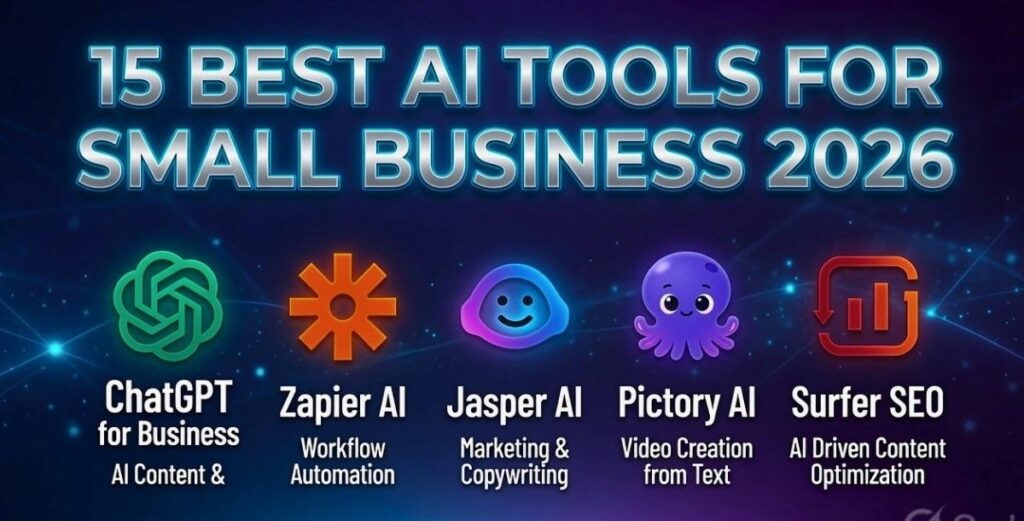
1. ChatGPT
Best For:
Content creation, customer support, brainstorming, research, and productivity.
ChatGPT remains one of the most versatile AI tools available.
Businesses use it to:
- Write blog posts
- Generate emails
- Create marketing copy
- Draft proposals
- Build SOPs
- Conduct research
Key Features
- Natural language conversations
- Advanced content generation
- Data analysis capabilities
- Coding assistance
- Custom GPTs
Pros
- Easy to use
- Flexible across industries
- Strong free plan
Cons
- Requires fact-checking
- Outputs depend on prompt quality
Pricing
- Free plan available
- Premium plans available for advanced features
2. Claude
Best For:
Long-form writing and document analysis.
Developed by Anthropic, Claude excels at handling lengthy documents and generating high-quality content.
Key Features
- Large context window
- Strong reasoning capabilities
- Excellent writing quality
Pros
- Great for reports
- Handles large files well
Cons
- Smaller ecosystem than ChatGPT
3. Jasper AI
Best For:
Marketing teams and content agencies.
Jasper focuses heavily on marketing content creation.
Key Features
- Blog writing
- Ad copy generation
- SEO content workflows
- Brand voice customization
Pros
- Built specifically for marketers
- Team collaboration tools
Cons
- Higher pricing
4. Grammarly
Best For:
Business communication and editing.
Grammarly helps improve:
- Emails
- Blog posts
- Reports
- Sales proposals
Key Features
- Grammar correction
- Tone analysis
- AI rewriting
- Clarity suggestions
Pros
- Easy implementation
- Works across platforms
Cons
- Limited content generation compared to AI writers
5. Notion AI
Best For:
Knowledge management and productivity.
Notion AI combines note-taking with AI-powered assistance.
Use Cases
- Meeting summaries
- Project planning
- Documentation
- Team collaboration
Pros
- Excellent workspace management
- Strong collaboration features
Cons
- Learning curve for new users
6. HubSpot AI
Best For:
Marketing, sales, and CRM automation.
HubSpot integrates AI into customer relationship management.
Features
- Lead scoring
- Email generation
- Customer insights
- Workflow automation
Pros
- All-in-one platform
- Strong automation
Cons
- Can become expensive as you scale
7. Canva AI
Best For:
Graphic design and visual content.
Canva has become a favorite among small businesses.
Features
- AI image generation
- Magic Design
- Presentation creation
- Social media graphics
Pros
- Beginner-friendly
- Huge template library
Cons
- Advanced designers may want more customization
8. Midjourney
Best For:
High-quality AI image creation.
Businesses use Midjourney for:
- Marketing graphics
- Website visuals
- Product concepts
- Advertising creatives
Pros
- Outstanding image quality
- Creative flexibility
Cons
- Learning curve
9. Surfer SEO
Best For:
SEO content optimization.
Surfer helps businesses rank higher on Google.
Features
- Content scoring
- Keyword optimization
- SERP analysis
- Content briefs
Pros
- SEO-focused workflow
- Easy recommendations
Cons
- Requires content strategy knowledge
10. Semrush AI Tools
Best For:
SEO and competitive research.
Semrush offers AI-powered marketing tools for growing businesses.
Features
- Keyword research
- Competitor analysis
- Content optimization
- Site audits
Pros
- Comprehensive marketing suite
Cons
- Premium pricing
11. Ahrefs
Best For:
SEO professionals and content marketers.
Ahrefs remains one of the best SEO research platforms.
Features
- Keyword explorer
- Backlink analysis
- Rank tracking
- Content opportunities
Pros
- Industry-leading backlink data
Cons
- Can be expensive for beginners
12. Zapier AI
Best For:
Business automation.
Zapier connects thousands of apps without coding.
Popular Automations
- Lead management
- CRM updates
- Email workflows
- Customer onboarding
Pros
- Massive app ecosystem
- Saves significant time
Cons
- Complex workflows require setup
13. Fireflies AI
Best For:
Meeting transcription.
Fireflies records and summarizes meetings automatically.
Features
- Call recording
- AI summaries
- Action items
- Searchable transcripts
Pros
- Improves team productivity
Cons
- Depends on meeting audio quality
14. Synthesia
Best For:
AI video creation.
Businesses use Synthesia to create professional videos without cameras or studios.
Use Cases
- Training videos
- Product demos
- Marketing content
Pros
- Fast production
- Professional output
Cons
- Limited customization compared to traditional video production
15. Tidio AI
Best For:
Customer service automation.
Tidio combines chatbots with live chat.
Features
- AI customer support
- Lead generation
- Automated responses
Pros
- Easy implementation
- Improves response times
Cons
- Advanced features require paid plans
Comparison Table: Best AI Tools for Business
| Tool | Primary Use | Free Plan | Best For |
|---|---|---|---|
| ChatGPT | Content & Productivity | Yes | All businesses |
| Claude | Writing & Analysis | Yes | Writers |
| Jasper | Marketing Content | No | Agencies |
| Grammarly | Editing | Yes | Professionals |
| Notion AI | Productivity | Limited | Teams |
| HubSpot AI | CRM | Limited | Sales |
| Canva AI | Design | Yes | Small businesses |
| Midjourney | Images | No | Creators |
| Surfer SEO | SEO | No | Bloggers |
| Semrush | Marketing | Limited | Marketers |
| Ahrefs | SEO | Limited | SEO professionals |
| Zapier | Automation | Yes | Operations |
| Fireflies | Meetings | Yes | Teams |
| Synthesia | Video | No | Training |
| Tidio | Support | Yes | Ecommerce |
How to Choose the Best AI Tool for Your Business
Ask yourself these questions:
What Problem Are You Solving?
Examples:
- Content creation?
- Customer support?
- Automation?
- SEO?
- Design?
Start with the problem, not the software.
What Is Your Budget?
Many AI tools offer:
- Free plans
- Freemium models
- Monthly subscriptions
Small businesses can often start with:
- ChatGPT
- Canva
- Zapier
- Grammarly
for under $50–$100 monthly.
Will It Integrate With Existing Tools?
Check compatibility with:
- CRM software
- Email marketing tools
- Ecommerce platforms
- Analytics tools
Common Mistakes to Avoid
Using Too Many AI Tools
Many businesses buy multiple subscriptions but use only a few features.
Start small.
Ignoring Human Review
AI is powerful but not perfect.
Always review:
- Content
- Data
- Customer communications
Not Measuring ROI
Track:
- Time saved
- Leads generated
- Revenue growth
- Cost reductions
Best AI Tool Stack for Small Businesses
A practical starter stack:
| Function | Tool |
|---|---|
| Writing | ChatGPT |
| Design | Canva AI |
| SEO | Surfer SEO |
| Research | Ahrefs |
| CRM | HubSpot |
| Automation | Zapier |
| Meetings | Fireflies |
| Support | Tidio |
This combination covers most business needs without overwhelming your team.
If you’re building an AI-powered business, these related guides from Thinking Era Hub can help:
- Automate Business Processes: A Practical Guide for Small Businesses — https://thinkingerahub.com/automate-business-processes/ (Thinking Era Hub)
- AI Tools for Business: Smart Solutions for Digital Growth and Higher Profits — https://thinkingerahub.com/ai-tools-for-business/ (Thinking Era Hub)
- Automated CRM: The Smart Way to Manage Customers and Grow Faster — https://thinkingerahub.com/automated-crm/ (Thinking Era Hub)
- Business Analytics Software: A Complete Guide for Smarter Business Decisions — https://thinkingerahub.com/business-analytics-software/ (Thinking Era Hub)
These articles complement the strategies discussed in this guide and can help you build a more efficient business system.
Pricing and ROI Considerations
When evaluating AI software, focus on return on investment rather than monthly cost.
For example:
- Saving 10 hours per week can be worth hundreds of dollars monthly.
- Automating customer support can reduce staffing costs.
- Better SEO tools can increase organic traffic and sales.
A business spending $100 monthly on AI that generates an additional $1,000 in revenue achieves a strong ROI.
Who Should Use These AI Tools?
Ideal Users
- Bloggers
- Small business owners
- Ecommerce stores
- Marketing agencies
- Content creators
- Startup founders
- Consultants
Who Might Not Need Them
- Businesses with minimal digital operations
- Organizations unwilling to adopt automation
- Teams without clear workflows
Actionable Tips You Can Implement Today
- Start with one AI tool instead of five.
- Automate repetitive tasks first.
- Use AI to assist, not replace, expertise.
- Track time savings each month.
- Create standard prompts for recurring tasks.
- Train your team on AI best practices.
- Review outputs before publishing.
- Measure business results regularly.
Final Verdict
The best AI tools for business depend on your specific goals.
If you want one platform that delivers the most value overall, ChatGPT remains the strongest all-around solution.
For marketers, combining ChatGPT, Canva AI, Surfer SEO, and Semrush creates a powerful growth engine.
For operations and automation, Zapier and HubSpot can significantly improve efficiency.
The key is not using every AI tool available. It’s choosing a small number of tools that solve real business problems and generate measurable results.
Ready to transform your business with AI?
Start by testing one or two tools from this list and identify where automation can save the most time. Then expand gradually as you measure results.
For more practical business growth strategies, SEO guides, automation tips, and software recommendations, explore the latest resources on Thinking Era Hub.
Conclusion
AI is quickly becoming a competitive advantage for businesses of all sizes. The right tools can help you create content faster, automate workflows, improve customer experiences, and increase profitability.
By selecting the best AI tools for business based on your goals and budget, you can build a smarter, more efficient company that scales without dramatically increasing costs.
The sooner you start experimenting with AI, the faster you’ll discover opportunities to grow and stay ahead of competitors.
FAQ Section
What is the best AI tool for business overall?
ChatGPT is often considered the best all-around AI tool because it supports content creation, research, productivity, customer service, and business operations.
Which AI tool is best for small businesses?
Canva AI, ChatGPT, Zapier, and HubSpot are excellent choices for small businesses due to their ease of use and strong ROI.
Are AI tools worth the cost?
Yes. Many businesses save time, reduce labor costs, improve efficiency, and generate more revenue through AI-powered automation.
Can AI replace employees?
AI works best as an assistant rather than a replacement. It handles repetitive tasks while humans focus on strategy, creativity, and decision-making.
What is the best AI tool for SEO?
Surfer SEO, Ahrefs, and Semrush are among the best AI-assisted SEO platforms for keyword research, content optimization, and competitor analysis.
Which AI tool is best for content creation?
ChatGPT, Claude, and Jasper AI are leading solutions for creating blog posts, marketing content, emails, and social media copy.
How much should a small business spend on AI tools?
Many small businesses can build an effective AI toolkit for $50 to $200 per month, depending on their needs and growth stage.
Can beginners use AI tools?
Absolutely. Most modern AI platforms are designed for non-technical users and require little to no coding knowledge.