
Artificial Intelligence (AI) is no longer a futuristic concept reserved for scientists and programmers. It has quietly become part of everyday life, influencing how people search online, shop, communicate, work, and even receive healthcare. Whether you realize it or not, AI is already helping you make decisions every single day.
Yet, despite its growing presence, many people still find AI confusing. Terms like machine learning, generative AI, neural networks, and large language models often sound technical and intimidating. This knowledge gap can make it difficult for beginners, bloggers, entrepreneurs, and small business owners to understand how AI can actually benefit them.
The good news is that you don’t need a computer science degree to understand AI. Learning the basics can help you work smarter, save time, improve productivity, and make informed decisions about the tools you use.
In this beginner-friendly guide, you’ll learn:
- What AI really means
- How AI works without complicated technical jargon
- Different types of AI
- Real-life examples of AI
- Common myths about AI
- Benefits and limitations
- Practical ways to start using AI today
Whether you’re a blogger, digital marketer, content creator, freelancer, student, or business owner, this guide will give you a solid foundation in AI knowledge.
What Is AI Knowledge?
AI knowledge refers to understanding the basic concepts, capabilities, limitations, and practical applications of Artificial Intelligence. It doesn’t mean learning how to code or build AI models. Instead, it’s about knowing what AI can do, where it is used, and how to use it effectively.
For non-technical users, AI knowledge includes understanding:
- How AI learns from data
- What tasks AI performs well
- Where AI makes mistakes
- Which AI tools solve everyday problems
- How to use AI responsibly
Today, AI knowledge is becoming as valuable as basic computer literacy. Just as learning to use the internet became essential over the past two decades, understanding AI is quickly becoming an important digital skill.
Why AI Knowledge Matters More Than Ever
The world is rapidly adopting AI across almost every industry.
Businesses use AI to automate repetitive tasks.
Teachers use AI to create lesson plans.
Doctors use AI to assist in diagnosing diseases.
Marketers use AI to write content and analyze customer behavior.
Online stores use AI to recommend products.
Search engines rely on AI to deliver more relevant results.
Understanding AI gives you a competitive advantage because it helps you:
- Make better business decisions
- Save time through automation
- Improve productivity
- Learn new digital skills
- Stay competitive in the job market
- Avoid misinformation about AI
People who understand AI are better prepared for the future than those who ignore it.
How Artificial Intelligence Works (Without Technical Jargon)
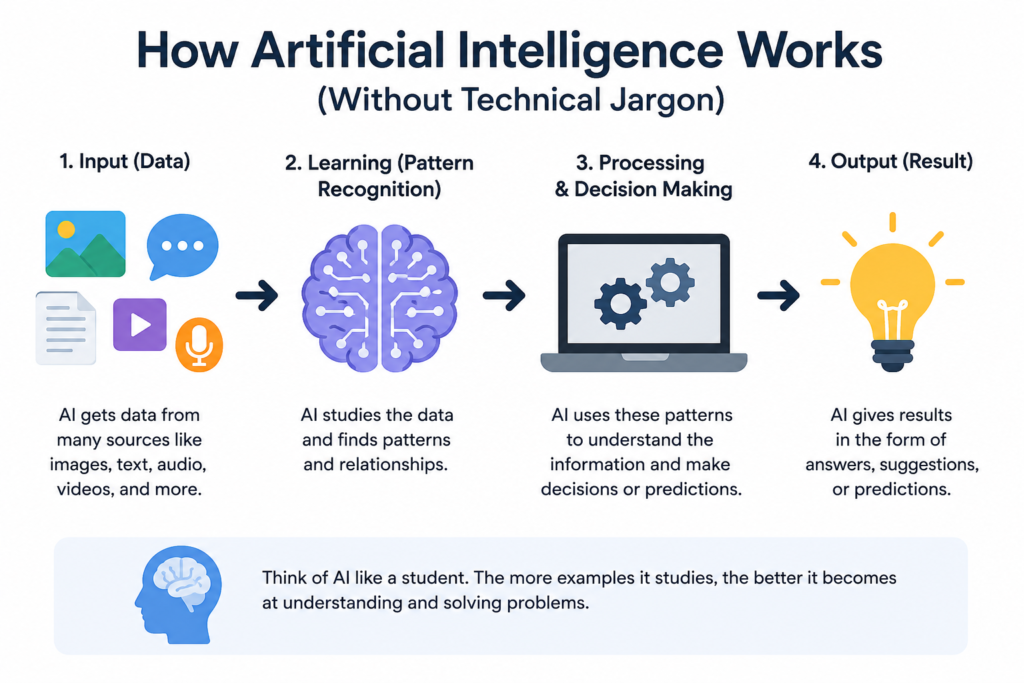
Many people imagine AI as a robot that thinks like a human. In reality, AI is software designed to recognize patterns, analyze information, and make predictions based on data.
Think of AI like a student.
Instead of attending school, AI studies millions or even billions of examples.
For example:
- It reads books.
- It analyzes websites.
- It examines images.
- It processes videos.
- It learns from conversations.
After studying enough information, AI becomes capable of recognizing patterns and generating useful responses.
For instance:
If thousands of pictures labeled “cat” are shown to an AI system, it eventually learns what a cat looks like. When shown a new image, it can predict whether the picture contains a cat.
The same concept applies to text, speech, music, and many other types of information.
The Four Main Types of Artificial Intelligence
Understanding the different categories of AI helps beginners see why today’s AI tools are impressive yet still limited.
1. Reactive AI
Reactive AI performs one specific task and does not remember past interactions.
Examples include:
- Chess-playing computers
- Spam email filters
- Basic recommendation systems
Reactive AI is fast but cannot learn from previous experiences.
2. Limited Memory AI
Most modern AI tools fall into this category.
They learn from historical data to improve future decisions.
Examples include:
- Self-driving vehicle systems
- AI chatbots
- Fraud detection software
- Voice assistants
Popular AI platforms like ChatGPT and many business automation tools rely on limited memory techniques.
3. Theory of Mind AI
This type of AI would understand emotions, intentions, beliefs, and social interactions similarly to humans.
Researchers are actively exploring this area, but it has not yet been achieved in real-world applications.
4. Artificial General Intelligence (AGI)
Artificial General Intelligence refers to AI capable of performing any intellectual task that a human can do.
Unlike today’s AI systems, AGI would adapt across different domains without needing specialized training for each task.
AGI remains a long-term research goal rather than a reality.
Common AI Technologies You Should Know
Many AI terms sound complicated, but their core ideas are straightforward.
Machine Learning
Machine Learning enables computers to learn from data instead of relying only on fixed programming.
The more quality data an AI system receives, the better it usually becomes at recognizing patterns and making predictions.
Examples include:
- Product recommendations
- Fraud detection
- Email filtering
- Search ranking
Natural Language Processing (NLP)
Natural Language Processing allows AI to understand and generate human language.
This technology powers:
- AI chatbots
- Translation tools
- Virtual assistants
- Grammar checkers
- AI writing assistants
If you’ve ever chatted with an AI assistant or translated text online, you’ve already experienced NLP.
Computer Vision
Computer Vision enables machines to interpret and understand images and videos.
Examples include:
- Face recognition
- Medical image analysis
- Quality inspection in manufacturing
- Object detection in self-driving vehicles
Generative AI
Generative AI creates entirely new content instead of simply analyzing existing information.
It can generate:
- Articles
- Images
- Videos
- Code
- Music
- Presentations
- Marketing copy
This is one of the fastest-growing areas of AI and is transforming creative and business workflows.
For a deeper introduction to AI fundamentals, you may also enjoy our guide on Beginner’s Guide to Artificial Intelligence:
https://thinkingerahub.info/beginners-guide-to-artificial-intelligence/
Real-Life Examples of AI You Already Use
One of the biggest misconceptions is that AI only exists in high-tech laboratories or expensive business software. In reality, most people interact with AI every day without realizing it.
Smartphones
Modern smartphones use AI to:
- Improve camera quality
- Recognize faces for unlocking
- Predict text while typing
- Filter spam calls
- Optimize battery life
These features make devices more helpful without requiring users to understand the underlying technology.
Search Engines
When you search for information online, AI helps determine which results are most relevant.
Search engines analyze factors such as:
- Search intent
- Content quality
- User behavior
- Website authority
- Freshness of information
This is why two people searching for similar topics may receive slightly different results.
Streaming Services
Platforms like Netflix and Spotify use AI recommendation systems to personalize content.
Instead of showing everyone the same movies or songs, AI analyzes viewing and listening habits to suggest content that matches individual preferences.
Online Shopping
E-commerce websites rely heavily on AI to improve the shopping experience.
AI can:
- Recommend products
- Predict demand
- Detect fraudulent transactions
- Personalize discounts
- Improve customer support
These features help both businesses and customers save time while making better purchasing decisions.
How AI Is Transforming Businesses
AI is no longer limited to large technology companies. Affordable AI tools now allow businesses of all sizes to automate routine work, improve customer experiences, and make smarter decisions.
Marketing Automation
AI helps marketers:
- Generate blog ideas
- Write email campaigns
- Analyze customer behavior
- Improve SEO strategies
- Create social media content
If you’re interested in practical business applications, read our article on Best AI Tools for Business:
https://thinkingerahub.info/best-ai-tools-for-business/
Small businesses can now compete more effectively by using AI to reduce manual work and focus on growth.
AI in Customer Service
Businesses increasingly use AI-powered chatbots and virtual assistants to answer common customer questions around the clock. These tools can:
- Respond instantly to frequently asked questions
- Route customers to the right department
- Handle simple support requests
- Reduce wait times
- Improve customer satisfaction
For small businesses, AI customer service tools can provide enterprise-level support without the cost of a large support team.
Benefits of Understanding AI Knowledge
Learning the basics of AI offers more than just technical awareness. It gives you practical skills that can improve your work, business, and everyday life.
1. Saves Time
AI automates repetitive tasks such as:
- Writing first drafts
- Summarizing long documents
- Organizing data
- Scheduling meetings
- Managing emails
This allows you to focus on work that requires creativity and decision-making.
2. Increases Productivity
AI tools can help you complete tasks faster without sacrificing quality.
Examples include:
- Creating marketing content
- Researching topics
- Brainstorming ideas
- Editing documents
- Generating reports
3. Supports Better Decision-Making
AI analyzes large amounts of information quickly, helping businesses identify trends and make informed decisions.
Examples include:
- Sales forecasting
- Customer behavior analysis
- Inventory planning
- Marketing performance tracking
4. Improves Learning
AI-powered educational platforms adapt lessons based on a learner’s progress, making education more personalized and engaging.
5. Creates New Business Opportunities
Entrepreneurs use AI to:
- Launch online businesses
- Build websites faster
- Produce digital products
- Automate customer support
- Scale content marketing
Understanding AI can help you identify opportunities that competitors may overlook.
Common Myths About Artificial Intelligence
Many misconceptions prevent people from exploring AI. Let’s separate fact from fiction.
| Myth | Reality |
|---|---|
| AI will replace every job. | AI is more likely to automate specific tasks than replace all jobs. Human creativity, judgment, and communication remain valuable. |
| AI is always correct. | AI can make mistakes, provide outdated information, or misunderstand context. Human review is essential. |
| AI is only for programmers. | Many AI tools are designed for beginners and require no coding skills. |
| AI can think like humans. | Today’s AI recognizes patterns and generates responses, but it does not possess human consciousness or emotions. |
| AI is too expensive. | Many AI tools offer free plans or affordable pricing for individuals and small businesses. |
AI Knowledge vs. AI Skills
Understanding the difference between AI knowledge and AI skills can help you choose the right learning path.
| Area | AI Knowledge | AI Skills |
|---|---|---|
| Focus | Understanding concepts | Applying AI tools |
| Coding Required | No | Sometimes |
| Beginner Friendly | Yes | Yes, depending on the tool |
| Learning Goal | Build awareness | Solve real-world problems |
| Examples | Learning AI terminology | Creating content with AI, automating workflows, analyzing data |
For most beginners, building AI knowledge first makes learning practical AI skills much easier.
Best Practices for Using AI
Using AI effectively requires more than entering a prompt. Follow these best practices to get better results.
Start With Clear Goals
Know what you want AI to help you achieve. A clear objective leads to more accurate responses.
Write Better Prompts
Instead of asking:
“Write an article.”
Try:
“Write a beginner-friendly 1,500-word article explaining AI knowledge with practical examples.”
Specific prompts produce better outcomes.
Verify Information
Always fact-check important information, especially when writing about:
- Health
- Finance
- Legal topics
- Statistics
- News
Use trusted sources such as:
- Google AI
- OpenAI
- Anthropic
- HubSpot
- Ahrefs
- Semrush
- Search Engine Journal
Protect Sensitive Information
Avoid sharing confidential business information, customer data, passwords, or personal financial details with AI tools unless you fully understand the platform’s privacy policies.
Combine AI With Human Creativity
AI works best when it supports your thinking rather than replacing it. Review, edit, and personalize AI-generated content before publishing.
Common Mistakes Beginners Should Avoid
Learning AI becomes much easier when you avoid these common errors.
Expecting Perfect Answers
AI can provide excellent assistance, but it is not perfect. Always review the output for accuracy and clarity.
Using Vague Prompts
General prompts often produce generic responses. Be as specific as possible.
Ignoring Human Editing
Publishing AI-generated content without editing can lead to factual errors, inconsistent tone, or missed opportunities to add personal insights.
Believing Every AI Tool Is the Same
Different AI platforms have different strengths. Some are better for writing, while others excel at coding, image generation, research, or automation.
Failing to Keep Learning
AI evolves rapidly. Staying informed about new tools and trends helps you continue benefiting from the latest innovations.
For ongoing updates, explore our article on AI News and Trends for Business:
https://thinkingerahub.info/ai-news-and-trends-for-business/
Popular AI Tools Compared
The AI landscape includes tools designed for different needs. Here’s a quick comparison.
| Tool | Primary Use | Free Plan | Best For |
|---|---|---|---|
| ChatGPT | Writing, brainstorming, coding, research | Yes | Beginners, bloggers, marketers |
| Google Gemini | Productivity, research, Google Workspace | Yes | Google ecosystem users |
| Claude | Long-form writing and document analysis | Yes | Writers and professionals |
| Microsoft Copilot | Office productivity | Yes | Microsoft 365 users |
| Perplexity AI | AI-powered search and research | Yes | Researchers and students |
Choose the tool that best matches your goals rather than assuming one platform is ideal for every task.
Pros and Cons of Learning AI Knowledge
Pros
- Easy to learn without coding
- Improves digital literacy
- Saves time on routine tasks
- Supports better business decisions
- Helps automate repetitive work
- Increases productivity
- Creates new income opportunities
- Enhances creativity
Cons
- AI can produce inaccurate information
- Some advanced tools require paid subscriptions
- Overreliance on AI may reduce critical thinking
- Privacy concerns exist when handling sensitive data
- Rapid changes require continuous learning
Pricing and Cost Considerations
The good news is that learning AI doesn’t require a large budget.
Free Options
Many leading AI platforms offer free plans with enough features for beginners to learn and experiment.
Examples include:
- ChatGPT Free
- Google Gemini Free
- Microsoft Copilot
- Perplexity AI
Paid Plans
Paid subscriptions typically include:
- Faster responses
- Higher usage limits
- Access to advanced AI models
- Better collaboration features
- Priority access to new capabilities
ROI Considerations
Investing in AI tools can deliver a strong return by helping you:
- Save hours each week
- Produce more content
- Improve marketing performance
- Increase business efficiency
- Reduce outsourcing costs
For many freelancers, bloggers, and entrepreneurs, the time saved often outweighs the subscription cost.
Who Should Learn AI Knowledge?
AI knowledge is valuable for many people, especially those working in digital environments.
Ideal Users
- Bloggers
- Content creators
- Small business owners
- Freelancers
- Students
- Teachers
- Digital marketers
- Online entrepreneurs
- Customer support teams
- Sales professionals
Who May Not Need Advanced AI Knowledge?
If your work rarely involves technology, advanced AI concepts may not be necessary. However, understanding the basics is still beneficial because AI is becoming part of everyday digital life.
Actionable Tips to Start Using AI Today
You don’t need to become an expert overnight. Start with these simple steps.
- Learn one AI tool at a time.
- Practice writing detailed prompts.
- Use AI to automate repetitive tasks.
- Verify important information before sharing it.
- Follow trusted AI news sources.
- Experiment with different AI platforms.
- Keep learning as AI technology evolves.
Consistency is more important than speed. Even spending a few minutes each day exploring AI can build valuable skills over time.
Final Verdict
AI is no longer a technology reserved for engineers or large corporations. It has become an everyday tool that helps people work more efficiently, solve problems, and make informed decisions.
The greatest strength of AI lies in its ability to automate repetitive work, improve productivity, and make information more accessible. At the same time, users should remember that AI is a tool—not a replacement for human judgment, creativity, or critical thinking.
By building a strong foundation in AI knowledge, you’ll be better prepared to adapt to new technologies, identify business opportunities, and use AI responsibly in both your personal and professional life.
Now that you understand the fundamentals of AI knowledge, the next step is to put that knowledge into practice.
Start by exploring beginner-friendly AI tools, experiment with simple everyday tasks, and continue learning through trusted resources. The sooner you become comfortable using AI, the more opportunities you’ll discover to save time, improve productivity, and grow your business or career.
If you’re interested in learning more, browse our AI guides at Thinking Era Hub for practical tutorials, AI tool reviews, and the latest industry insights.
Conclusion
Understanding AI Knowledge Explained: What Every Non-Tech Person Should Know is one of the smartest investments you can make in today’s digital world. You don’t need programming experience to benefit from AI. By learning the basics, understanding its strengths and limitations, and using trusted AI tools responsibly, you can improve your workflow, make better decisions, and stay competitive in an increasingly AI-driven future.
Whether you’re a blogger, entrepreneur, marketer, student, or simply curious about technology, building your AI knowledge today will prepare you for tomorrow’s opportunities.
FAQ Section
1. What is AI knowledge?
AI knowledge is the understanding of how Artificial Intelligence works, where it is used, its benefits, limitations, and how people can use AI tools effectively without needing programming skills.
2. Do I need coding skills to learn AI?
No. Most beginners can learn AI concepts and use popular AI tools without writing any code.
3. Why is AI knowledge important?
AI knowledge helps individuals save time, improve productivity, make better decisions, and adapt to technologies that are increasingly used in business, education, and everyday life.
4. What are the best AI tools for beginners?
Popular beginner-friendly AI tools include ChatGPT, Google Gemini, Claude, Microsoft Copilot, and Perplexity AI.
5. Can AI replace human jobs?
AI is more likely to automate repetitive tasks than replace all jobs. Human creativity, leadership, empathy, and critical thinking remain essential.
6. Is AI always accurate?
No. AI can generate incorrect or outdated information. Always verify important facts using reliable sources before making decisions or publishing content.
7. How can small businesses benefit from AI?
Small businesses can use AI to automate customer support, create marketing content, analyze customer data, improve productivity, and reduce operational costs.
8. What’s the best way to start learning AI?
Begin by understanding basic AI concepts, experiment with free AI tools, practice writing effective prompts, and continue learning through trusted educational resources and hands-on experience.