
Artificial intelligence is evolving faster than ever. Every few months, new AI models promise better reasoning, faster responses, improved coding abilities, and more accurate content generation. With so many options available, choosing the right model has become increasingly difficult.
That is why AI models ranking has become one of the most searched topics among bloggers, developers, marketers, business owners, and AI enthusiasts.
Should you choose OpenAI’s latest model? Is Anthropic’s Claude better for long documents? Does Google’s Gemini outperform competitors for research? Are open-source models finally catching up?
The answer depends on your goals.
A model that ranks first for programming may not be the best choice for content writing. Likewise, a model with the highest benchmark score may not offer the best value for a small business.
In this guide, you’ll learn:
- What AI model rankings actually measure
- How AI models are evaluated
- The leading AI models in 2026
- Which models perform best for different tasks
- How to choose the right AI model for your budget and workflow
Whether you’re building AI-powered applications, creating blog content, automating business tasks, or simply exploring the latest technology, this guide will help you make an informed decision.
Blog Post Content
What Is an AI Models Ranking?
An AI models ranking is a comparison of artificial intelligence models based on standardized tests, real-world performance, and practical capabilities.
Instead of relying on marketing claims, ranking systems evaluate how well a model performs across multiple categories, including:
- Reasoning
- Coding
- Mathematics
- Writing
- Research
- Multilingual understanding
- Long-context processing
- Image understanding
- Speed
- Cost efficiency
These rankings help businesses and individuals identify the right AI model for specific use cases rather than simply choosing the newest release.
As AI continues to advance, rankings change frequently because developers constantly release updated versions with improved capabilities.
Why AI Models Ranking Matters
Selecting the wrong AI model can lead to:
- Higher operating costs
- Slower workflows
- Less accurate outputs
- Poor customer experiences
- Reduced productivity
Choosing the right model can help you:
- Produce better content
- Automate repetitive work
- Improve coding productivity
- Analyze data faster
- Reduce operational costs
- Scale AI projects more efficiently
For companies investing heavily in AI, even small performance improvements can translate into significant productivity gains.
How AI Models Are Ranked
Not every ranking website uses the same methodology. However, most evaluate AI models using several common criteria.
1. Reasoning Ability
Reasoning measures how effectively a model solves complex problems.
Strong reasoning enables an AI model to:
- Understand complicated instructions
- Solve logical puzzles
- Plan multiple steps
- Explain decisions clearly
Modern reasoning benchmarks are especially important for business automation and AI agents.
2. Coding Performance
Many developers rely on AI for programming assistance.
Coding evaluations typically measure how well models:
- Generate code
- Debug software
- Explain programming concepts
- Complete coding challenges
- Build applications
For software teams, coding ability is often one of the most important ranking factors.
3. Writing Quality
Content creators increasingly depend on AI.
High-ranking writing models should produce:
- Natural language
- Accurate information
- Well-structured articles
- Marketing copy
- Email campaigns
- Product descriptions
If you’re creating SEO content, you may also enjoy our guide to AI workflow automation software, which explores how AI can automate content production and repetitive marketing tasks.
4. Long Context Understanding
Some AI models can process entire books or large technical documents in one conversation.
Long-context capabilities benefit:
- Researchers
- Lawyers
- Financial analysts
- Enterprise users
- Content teams
Models with larger context windows can maintain accuracy across longer discussions.
5. Speed and Efficiency
Performance is not only about intelligence.
Businesses also evaluate:
- Response speed
- API latency
- Infrastructure reliability
- Cost per request
- Scalability
These factors become especially important for organizations handling thousands of AI requests daily.
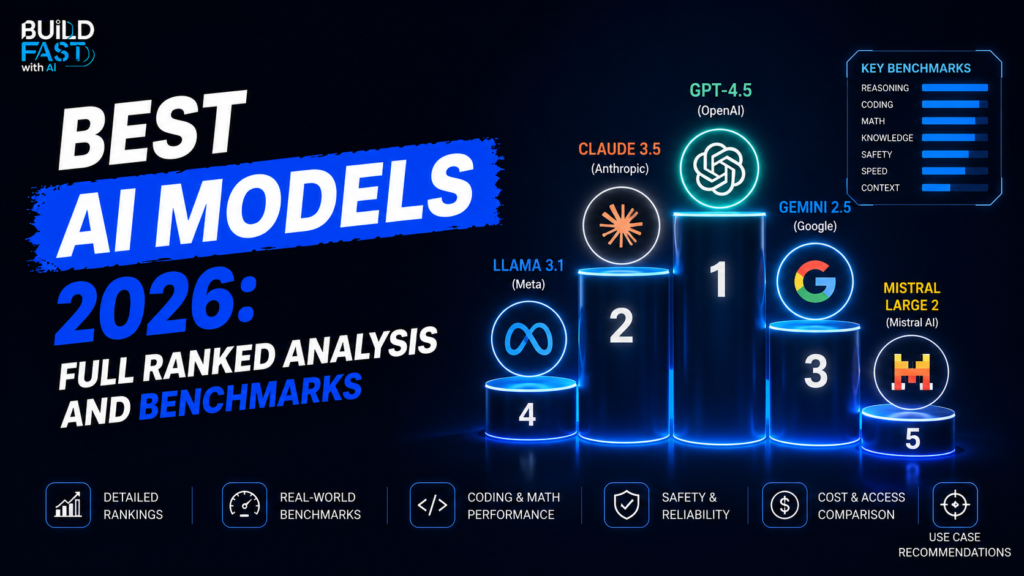
The Current AI Models Ranking Landscape
While rankings vary across benchmark platforms, several companies consistently lead the industry.
| AI Model | Strength | Best For |
|---|---|---|
| OpenAI GPT | Balanced performance | Content, coding, business |
| Anthropic Claude | Long-context reasoning | Research, analysis |
| Google Gemini | Multimodal AI | Search, productivity |
| xAI Grok | Real-time information | Current events |
| Meta Llama | Open-source flexibility | Developers |
Keep in mind that no single model dominates every benchmark. The best choice depends on the task you want to accomplish.
Factors That Influence AI Rankings
Benchmark Performance
Independent organizations regularly test AI models using standardized evaluations.
Popular benchmark categories include:
- Logical reasoning
- Mathematics
- Programming
- Language understanding
- Scientific knowledge
High benchmark scores often indicate stronger overall capabilities, but they should not be the only factor in your decision.
Real-World Performance
A model can perform exceptionally well on benchmarks yet struggle with practical business tasks.
Real-world testing often focuses on:
- Customer support
- SEO writing
- Document summarization
- Workflow automation
- Research assistance
- Marketing campaigns
Businesses increasingly prioritize practical usability over benchmark scores alone.
Cost Efficiency
A more powerful AI model is not always the most economical option.
Before choosing a model, consider:
- Subscription costs
- API pricing
- Token limits
- Daily usage
- Team size
For many small businesses, balancing performance with affordability delivers the best return on investment.
AI Models for Different Use Cases
Best for Bloggers
Bloggers benefit from models that excel at:
- Long-form writing
- SEO optimization
- Content planning
- Keyword clustering
- Content refreshing
To stay updated on the rapidly changing AI landscape, you can also explore our coverage of AI News TechCrunch, which highlights recent developments shaping modern AI systems.
Best for Digital Marketers
Marketing professionals often prioritize:
- Landing page copy
- Email campaigns
- Social media content
- Ad copy
- Customer segmentation
- Automation workflows
The ideal model combines strong writing quality with reliable reasoning and workflow integration.
Best for Developers
Developers typically value:
- Code generation
- Code explanation
- API assistance
- Debugging
- Documentation
- Technical reasoning
Open-source models may appeal to teams seeking greater customization, while commercial models often provide stronger out-of-the-box performance.
Best for Small Businesses
Small business owners usually need an AI assistant capable of handling multiple tasks, including:
- Customer support
- Content creation
- Market research
- Email writing
- Document summaries
- Business planning
A balanced, general-purpose model is often the most practical choice for these users.
Key Takeaways
- AI model rankings compare models across reasoning, coding, writing, speed, and cost.
- The highest-ranked model is not always the best fit for every use case.
- Businesses should evaluate real-world performance alongside benchmark scores.
- Bloggers, marketers, developers, and entrepreneurs have different AI requirements.
- Choosing the right AI model can improve productivity while reducing costs.
Choosing the Right AI Model: A Step-by-Step Guide
Finding the best AI model isn’t about picking the one with the highest benchmark score. Instead, match the model’s strengths to your specific needs.
Step 1: Define Your Primary Goal
Ask yourself what you’ll use AI for most often.
- Writing blog posts
- SEO optimization
- Software development
- Customer support
- Research
- Marketing automation
- Data analysis
- Image understanding
Your primary use case should guide your decision.
Step 2: Consider Your Budget
AI costs can vary significantly depending on usage.
Think about:
- Monthly subscription fees
- API pricing
- Team collaboration needs
- Expected daily prompts
- Long-term scalability
Many businesses start with a free plan before upgrading as their AI usage grows.
Step 3: Evaluate Integrations
A powerful AI model becomes even more valuable when it fits into your existing workflow.
Look for integrations with:
- Google Workspace
- Microsoft 365
- Slack
- Notion
- GitHub
- Zapier
- CRM platforms
- CMS platforms like WordPress
Good integrations reduce manual work and improve productivity.
Step 4: Test Real-World Tasks
Before committing to a subscription, try tasks you perform every day.
For example:
- Write a blog outline.
- Summarize a PDF.
- Generate marketing emails.
- Debug code.
- Analyze a spreadsheet.
- Create social media captions.
Comparing outputs from multiple models provides more useful insights than relying solely on benchmark scores.
AI Models Comparison
The table below summarizes how leading AI models generally compare across common business and productivity tasks.
| Feature | OpenAI GPT | Claude | Gemini | Llama |
|---|---|---|---|---|
| Writing Quality | Excellent | Excellent | Very Good | Good |
| Coding | Excellent | Very Good | Very Good | Good |
| Reasoning | Excellent | Excellent | Very Good | Good |
| Long Context | Very Good | Excellent | Excellent | Good |
| Multimodal Support | Excellent | Very Good | Excellent | Limited (varies by version) |
| API Availability | Yes | Yes | Yes | Yes |
| Open Source | No | No | No | Yes |
| Best For | General productivity | Research & analysis | Google ecosystem | Custom AI projects |
Performance can change as vendors release new model versions.
Best Practices for Getting Better AI Results
Even the highest-ranked model can produce poor results if prompted incorrectly.
Write Clear Instructions
Instead of writing:
“Write an article.”
Try:
“Write a 1,500-word beginner-friendly SEO article with H2 headings, examples, FAQs, and actionable tips.”
Specific instructions produce more reliable responses.
Provide Context
AI performs better when it understands your objective.
Include information such as:
- Target audience
- Tone
- Word count
- Industry
- Desired outcome
- Formatting requirements
The more relevant context you provide, the more accurate the output.
Verify Important Information
Although modern AI models are highly capable, they can still make mistakes.
Always verify:
- Statistics
- Financial data
- Legal advice
- Medical information
- Dates
- Product specifications
Cross-checking information is especially important for published content.
Keep Sensitive Data Secure
Avoid entering confidential information unless your organization’s privacy policies permit it.
Examples include:
- Customer records
- Passwords
- Financial statements
- Proprietary source code
- Personal identification details
Review the provider’s privacy and data retention policies before using AI for sensitive work.
Common Mistakes to Avoid
Many users judge AI models too quickly.
Avoid these common mistakes.
Choosing Based Only on Rankings
The number one model may not be the best choice for your workflow.
A content creator has different needs than a software engineer.
Ignoring Total Cost
API costs can increase rapidly as usage grows.
Estimate monthly usage before selecting a platform.
Using Generic Prompts
Vague prompts usually produce average results.
Invest time in learning prompt engineering fundamentals to improve output quality.
Not Testing Multiple Models
Different models excel in different areas.
Testing several options helps you identify the best fit for your projects.
Pros and Cons of Following AI Model Rankings
Pros
- Makes comparing AI platforms easier.
- Highlights strengths and weaknesses.
- Saves research time.
- Helps businesses make informed purchasing decisions.
- Encourages vendors to improve their products.
- Simplifies vendor evaluation.
Cons
- Rankings change frequently.
- Benchmarks may not reflect real-world tasks.
- Different ranking sites use different methodologies.
- Higher-ranked models are not always the most cost-effective.
- Personal workflow preferences still matter.
Pricing and Cost Considerations
Most leading AI providers offer multiple pricing options.
| Pricing Option | Typical Use Case | Considerations |
|---|---|---|
| Free Plan | Learning and testing | Limited usage and features |
| Individual Subscription | Professionals | Predictable monthly cost |
| API Pricing | Developers and SaaS products | Pay based on usage |
| Enterprise Plan | Large organizations | Advanced security, administration, and support |
When evaluating cost, consider the return on investment rather than focusing only on the subscription price.
If AI saves several hours of work each week, the productivity gains can easily outweigh the monthly expense.
For further Ai related topics…
Who Should Use AI Model Rankings?
Ideal Users
AI model rankings are especially valuable for:
- Bloggers
- Content creators
- Digital marketers
- SEO professionals
- Small business owners
- Developers
- Students
- Researchers
- Startup founders
- Product managers
These users often need to compare models before investing time or money.
Who May Not Need Detailed Rankings?
You may not need to study rankings extensively if:
- You only use AI occasionally.
- Your current AI tool already meets your needs.
- Your tasks are simple and repetitive.
- You do not require advanced reasoning or coding features.
For casual users, ease of use may be more important than benchmark leadership.
Actionable Tips You Can Apply Today
- Identify the three AI tasks you perform most frequently.
- Test at least three leading AI models using identical prompts.
- Measure output quality instead of relying only on benchmark scores.
- Compare pricing before upgrading to a paid plan.
- Learn prompt engineering to maximize model performance.
- Revisit rankings every few months, as AI evolves rapidly.
- Stay informed about new model releases and feature updates.
- Integrate AI into repetitive workflows to improve productivity.
Final Verdict
AI model rankings are an excellent starting point, but they should not be your only decision-making tool.
The best AI model depends on your goals, budget, and daily workflow.
For most users, leading commercial models provide the strongest balance of reasoning, writing, coding, and productivity. Businesses that need flexibility or custom deployments may prefer open-source alternatives.
Rather than chasing the highest benchmark score, focus on solving real business problems. Test several models with your own tasks, compare the results, and choose the one that consistently delivers value.
As AI technology continues to evolve, expect rankings to shift. Reviewing updated comparisons regularly will help you stay ahead of competitors and make smarter technology investments.
Ready to find the best AI model for your workflow?
Start by testing several leading platforms with the same real-world tasks. Compare writing quality, reasoning, speed, pricing, and ease of use before making a long-term commitment.
For more practical AI tutorials, buying guides, and industry updates, explore additional resources on Thinking Era Hub to stay informed about the latest AI trends and tools.
Conclusion
Understanding AI models ranking helps you make smarter decisions when selecting an AI assistant for work, business, or personal projects.
The strongest model isn’t always the most expensive or the highest-ranked on benchmarks. The right choice is the one that consistently delivers accurate, efficient, and cost-effective results for your specific needs.
Whether you’re a blogger, marketer, developer, entrepreneur, or small business owner, evaluating models based on real-world performance, pricing, integrations, and usability will help you maximize your return on investment while staying competitive in an increasingly AI-driven world.
6. FAQ Section
1. What is an AI models ranking?
An AI models ranking compares artificial intelligence models based on factors such as reasoning, coding, writing quality, benchmark performance, speed, and overall usefulness. These rankings help users identify the best model for specific tasks.
2. Which AI model is currently ranked the best?
There is no universal winner. Top-performing models often come from OpenAI, Anthropic, Google, and leading open-source communities. The best choice depends on whether your priority is writing, coding, research, automation, or multimodal capabilities.
3. Are AI benchmark scores enough to choose a model?
No. Benchmarks provide valuable insights, but they do not always reflect real-world performance. It’s best to combine benchmark results with hands-on testing using your own workflows.
4. Which AI model is best for content creation?
Models with strong language understanding, long-context support, and consistent writing quality are generally the best choice for bloggers, marketers, and content creators.
5. Are open-source AI models good enough?
Yes. Modern open-source models have improved significantly and can perform well for many tasks, especially when customized. However, commercial models may still offer advantages in ease of use, support, and advanced capabilities.
6. How often do AI model rankings change?
AI rankings change frequently because providers regularly release new models, updates, and performance improvements. Reviewing updated rankings every few months helps ensure you’re using the most suitable solution.
7. What should businesses consider before choosing an AI model?
Businesses should evaluate:
- Accuracy
- Security
- Cost
- API availability
- Integration options
- Scalability
- Privacy policies
- Performance on real business tasks
8. Can beginners benefit from AI model rankings?
Yes. Rankings help beginners quickly compare leading AI models, understand their strengths, and choose a platform that fits their learning goals, budget, and intended use without extensive technical knowledge.