

Artificial intelligence (AI) is no longer a futuristic concept. It powers search engines, chatbots, recommendation systems, image generators, self-driving technology, and countless business tools. As AI continues to reshape industries, more people are asking the same question: What is the best way to learn artificial intelligence?
Whether you’re a student, blogger, entrepreneur, marketer, or software developer, learning AI can open new career opportunities and help you work more efficiently. The challenge is that there are thousands of courses, tutorials, and AI tools available today. Without a clear roadmap, it’s easy to waste time learning the wrong skills or jumping between topics.
The good news is that you don’t need a computer science degree to get started. With the right learning strategy, free resources, and consistent practice, anyone can build valuable AI skills.
In this guide, you’ll learn:
- What artificial intelligence really is.
- The best learning path for beginners.
- Essential skills you should master first.
- The best AI tools and platforms to practice with.
- Common mistakes that slow down progress.
- Practical tips to accelerate your learning.
You’ll also discover useful resources that can help you build real-world AI projects while staying up to date with the latest industry trends.
If you’re completely new to AI, you may also find our Beginner’s Guide to Artificial Intelligence helpful before diving deeper into this roadmap:
https://thinkingerahub.info/beginners-guide-to-artificial-intelligence/
What Is Artificial Intelligence?
Artificial intelligence refers to computer systems that can perform tasks that normally require human intelligence. These tasks include:
- Understanding language
- Recognizing images
- Solving problems
- Making predictions
- Generating text
- Writing code
- Analyzing data
- Automating repetitive work
Instead of following only fixed instructions, many AI systems learn patterns from data to improve their performance over time.
Today, AI is being used in:
- Healthcare
- Finance
- Education
- Marketing
- E-commerce
- Manufacturing
- Customer support
- Cybersecurity
- Content creation
- Software development
Because AI is becoming a core technology across industries, learning it today can provide long-term career and business advantages.
Why Learning Artificial Intelligence Matters in 2026
Artificial intelligence is transforming how businesses operate. Companies of every size are using AI to increase productivity, reduce costs, improve customer experiences, and make smarter decisions.
Here are just a few examples:
- Marketers use AI to generate content and optimize campaigns.
- Bloggers use AI for keyword research and content planning.
- Developers use AI coding assistants to write software faster.
- Customer support teams automate responses using AI chatbots.
- Business owners analyze customer behavior with AI-powered analytics.
Even if you don’t plan to become an AI engineer, understanding how AI works can make you significantly more valuable in today’s job market.
Some of the fastest-growing careers now require at least basic AI knowledge, including:
- Digital marketing
- Data analysis
- Product management
- Content creation
- Software engineering
- UX design
- SEO
- Business consulting
The Best Way to Learn Artificial Intelligence
Learning AI successfully isn’t about memorizing complex algorithms from day one. Instead, focus on building your knowledge step by step.
A practical roadmap looks like this:
- Understand AI fundamentals.
- Learn basic programming.
- Study machine learning concepts.
- Practice with real AI tools.
- Build projects.
- Learn from real-world examples.
- Stay updated with new AI developments.
Following this structured approach prevents information overload and helps you develop practical skills much faster.
Step 1: Understand the Fundamentals of AI
Before learning advanced topics, you should understand the basic concepts behind artificial intelligence.
Focus on learning:
Machine Learning
Machine learning allows computers to learn from data without being explicitly programmed for every situation.
Examples include:
- Spam email detection
- Movie recommendations
- Product suggestions
- Fraud detection
Deep Learning
Deep learning is a specialized branch of machine learning that uses neural networks with many layers.
It powers technologies like:
- ChatGPT
- Image recognition
- Speech recognition
- Autonomous vehicles
Natural Language Processing (NLP)
NLP helps computers understand and generate human language.
Popular NLP applications include:
- AI chatbots
- Language translation
- Voice assistants
- AI writing tools
Computer Vision
Computer vision enables machines to interpret visual information.
Examples include:
- Face recognition
- Medical imaging
- Self-driving cars
- Security cameras
Once you understand these concepts, you’ll find advanced AI topics much easier to learn.
Step 2: Learn Basic Programming
Many beginners think they must become expert programmers before learning AI. That’s not true.
However, learning some programming—especially Python—will make your AI journey much smoother.
Python is widely considered the best programming language for AI because it is:
- Easy to learn
- Beginner friendly
- Highly readable
- Supported by thousands of AI libraries
- Used by major AI companies
Popular Python libraries include:
- NumPy
- Pandas
- Scikit-learn
- TensorFlow
- PyTorch
- Matplotlib
Don’t worry about mastering every library immediately.
Start by learning:
- Variables
- Loops
- Functions
- Lists
- Dictionaries
- Reading files
- Basic object-oriented programming
These skills provide enough foundation for most beginner AI projects.
Step 3: Learn Machine Learning Concepts
Machine learning is the engine behind modern artificial intelligence.
Rather than jumping directly into complex mathematics, begin by understanding the core ideas.
Supervised Learning
The model learns using labeled data.
Examples:
- House price prediction
- Email spam detection
- Customer churn prediction
Unsupervised Learning
The model finds patterns without labeled examples.
Examples:
- Customer segmentation
- Product recommendations
- Market analysis
Reinforcement Learning
The AI learns by interacting with an environment and receiving rewards for good decisions.
Examples include:
- Robotics
- Game-playing AI
- Autonomous vehicles
Understanding these three learning methods will help you recognize how different AI systems solve different types of problems.
Step 4: Practice with Real AI Tools
Reading about AI is helpful, but practical experience accelerates learning.
Fortunately, many AI platforms allow beginners to experiment without writing much code.
Some of the most useful tools include:
| Tool | Primary Use | Best For |
|---|---|---|
| ChatGPT | Writing, coding, research | Beginners |
| Claude | Long-form writing and analysis | Researchers |
| Google Gemini | Productivity and search | Everyday users |
| Microsoft Copilot | Office productivity | Business users |
| Perplexity AI | Research and citations | Students and bloggers |
Working with these tools helps you understand prompt engineering, AI limitations, and practical workflows.
If you’re looking for additional AI software that businesses use every day, check out our guide on Best AI Tools for Business:
https://thinkingerahub.info/best-ai-tools-for-business/
Learning how professionals use these platforms provides valuable real-world experience that complements theoretical knowledge.
Step 5: Build Small AI Projects
The fastest learners don’t spend all their time watching tutorials—they build projects.
Even simple projects teach valuable lessons about how AI works in practice.
Here are a few beginner-friendly ideas:
AI Content Generator
Use a language model API to create blog post outlines, social media captions, or email drafts.
Image Classification
Train a model to recognize everyday objects or handwritten digits using publicly available datasets.
Sentiment Analysis
Analyze customer reviews to determine whether they express positive, negative, or neutral opinions.
AI Chatbot
Create a basic chatbot that answers frequently asked questions for a small business or personal website.
Resume Screening Tool
Build a simple application that categorizes resumes based on predefined criteria to understand text processing and automation.
These hands-on projects reinforce concepts like data preparation, model evaluation, and prompt design while giving you a portfolio you can continue to expand.
Step 6: Learn AI Ethics and Responsible AI
As AI becomes more powerful, learning how to use it responsibly is just as important as learning how to build it.
Responsible AI focuses on creating systems that are fair, transparent, secure, and beneficial to society.
Some key principles include:
Fairness
AI models should avoid discrimination based on race, gender, age, or other personal characteristics.
Transparency
Users should understand when AI is making decisions and how those decisions are reached whenever possible.
Privacy
Many AI systems rely on large datasets. Protecting personal information and complying with privacy regulations should always be a priority.
Security
AI applications should be designed to prevent misuse, data leaks, and malicious attacks.
Learning these principles early will help you build trustworthy AI solutions and prepare you for real-world projects.
Step 7: Stay Updated with AI Trends
Artificial intelligence evolves rapidly. New models, frameworks, and tools are released almost every month.
To stay ahead, make learning a continuous habit.
Follow trusted resources such as:
- Google AI
- OpenAI
- Anthropic
- Hugging Face
- DeepMind
- Microsoft AI
- NVIDIA AI
- Search Engine Journal
- HubSpot
- Semrush Blog
Reading industry news helps you understand:
- New AI models
- Business applications
- AI regulations
- Productivity tools
- Marketing automation
- AI-powered search
- Emerging career opportunities
You can also explore our AI news coverage for the latest developments:
https://thinkingerahub.info/ai-news-and-trends-for-business/
The Best Learning Resources for Artificial Intelligence
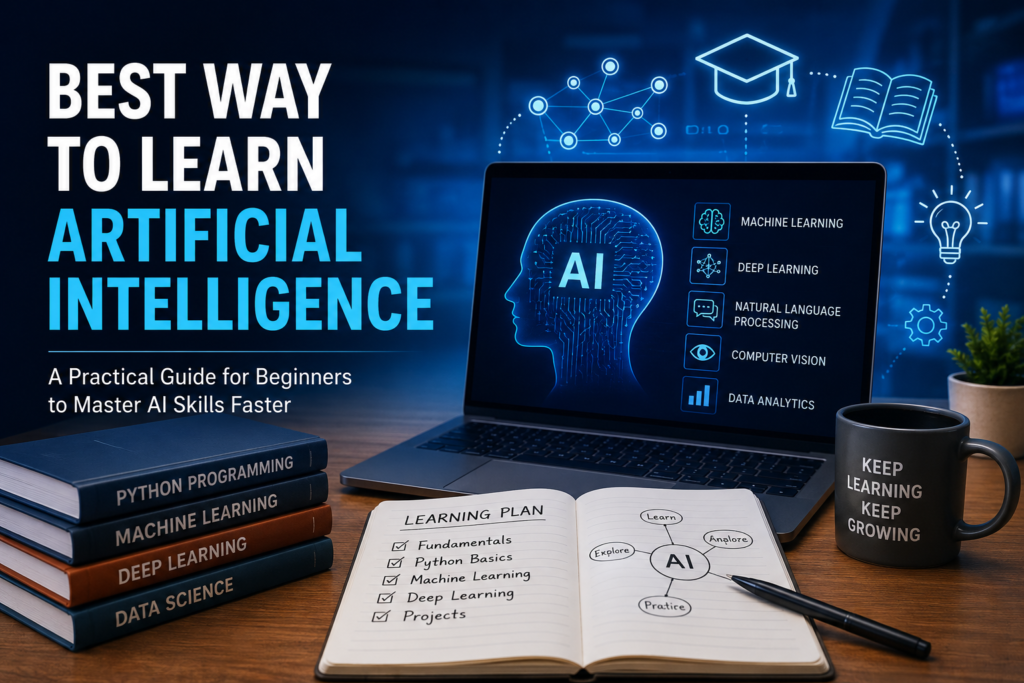
There are countless learning materials online, but not all are beginner-friendly.
Here are some of the best resources available.
| Resource | Type | Best For | Cost |
|---|---|---|---|
| Coursera | Online courses | Structured learning | Free & Paid |
| edX | University courses | Academic learning | Free & Paid |
| Udemy | Video courses | Practical skills | Paid |
| Kaggle | Practice platform | Machine learning projects | Free |
| Hugging Face | AI community | NLP and transformers | Free |
| Google AI | Documentation | Research and tutorials | Free |
| OpenAI Documentation | API learning | Developers | Free |
| Microsoft Learn | Interactive learning | Azure AI | Free |
Choose one or two platforms instead of trying everything at once. Consistency matters more than variety.
Build a Personal AI Learning Roadmap
A structured roadmap helps you stay focused and measure your progress.
Month 1: Learn the Basics
Focus on:
- What AI is
- Machine learning fundamentals
- Python basics
- Prompt engineering
- AI terminology
Goal:
Understand how modern AI systems work.
Month 2: Practice Daily
Start using AI tools for real tasks.
Examples:
- Generate blog outlines
- Write Python scripts
- Analyze datasets
- Build simple chatbots
- Create AI-powered workflows
Goal:
Become comfortable using AI every day.
Month 3: Build Projects
Create projects that solve real problems.
Examples include:
- AI writing assistant
- Customer support chatbot
- AI resume analyzer
- Image recognition app
- AI-powered recommendation system
Goal:
Develop a portfolio that demonstrates practical experience.
Month 4 and Beyond
Continue improving by learning:
- Deep learning
- Neural networks
- Large Language Models (LLMs)
- AI agents
- Retrieval-Augmented Generation (RAG)
- AI automation
- Cloud AI platforms
Learning AI is a long-term investment, but steady progress leads to significant results over time.
Best Practices for Learning Artificial Intelligence
Following proven strategies can dramatically improve your learning speed.
Learn by Doing
Reading books is valuable, but building projects creates lasting understanding.
Apply every new concept immediately.
Practice Every Week
Even spending 30 to 60 minutes a day can produce impressive results over several months.
Small, consistent efforts outperform occasional intensive study sessions.
Join AI Communities
Learning with others keeps you motivated.
Popular communities include:
- GitHub
- Discord
- Hugging Face Community
- Kaggle Discussions
- Stack Overflow
You can ask questions, receive feedback, and discover new ideas from experienced practitioners.
Read Real Documentation
Instead of relying only on YouTube videos, spend time reading official documentation.
This habit helps you understand how professional developers learn new technologies.
Experiment Frequently
Try different prompts.
Test different AI models.
Compare outputs.
The more you experiment, the faster you’ll understand each tool’s strengths and weaknesses.
Common Mistakes to Avoid
Many beginners slow their progress by making avoidable mistakes.
Trying to Learn Everything at Once
Artificial intelligence is a broad field.
Focus on one topic before moving to the next.
Ignoring Python
Even if you mainly use no-code AI tools, basic Python knowledge gives you much greater flexibility.
Watching Tutorials Without Practice
Watching videos feels productive, but real learning happens when you build something yourself.
Chasing Every New AI Tool
Hundreds of new AI tools launch every month.
Master a few reliable tools before exploring new ones.
Giving Up Too Early
AI concepts may seem challenging at first.
Persistence is often the biggest difference between successful learners and those who quit.
AI Learning Path Comparison
| Learning Path | Difficulty | Time Required | Best For |
|---|---|---|---|
| AI Tools Only | Easy | 2–4 weeks | Bloggers, marketers, entrepreneurs |
| Python + AI Fundamentals | Moderate | 2–4 months | Beginners |
| Machine Learning | Moderate to Advanced | 4–8 months | Aspiring AI engineers |
| Deep Learning | Advanced | 6–12 months | Researchers and developers |
| AI Engineering | Advanced | 8–18 months | Professional AI careers |
Pros and Cons of Learning Artificial Intelligence
Pros
- High demand across industries
- Excellent career opportunities
- Strong earning potential
- Useful for entrepreneurs and freelancers
- Automates repetitive work
- Improves productivity
- Supports innovation
- Future-proof technical skill
Cons
- Requires continuous learning
- Some concepts involve mathematics
- Technology changes quickly
- Advanced topics can be challenging
- Building expertise takes time
Cost Considerations
The good news is that you can begin learning AI with little or no investment.
| Learning Option | Estimated Cost |
|---|---|
| YouTube Tutorials | Free |
| Google AI Resources | Free |
| OpenAI Documentation | Free |
| Hugging Face | Free |
| Kaggle | Free |
| Coursera Certificates | Optional Paid |
| Udemy Courses | Low Cost |
| AI APIs | Pay as you use |
Free Learning Path
If you’re on a tight budget, combine:
- Free YouTube tutorials
- Kaggle exercises
- Google AI documentation
- OpenAI documentation
- Hugging Face tutorials
This combination provides an excellent foundation before investing in premium courses.
Who Should Learn Artificial Intelligence?
Artificial intelligence is valuable for many different professionals.
Ideal For
- Students
- Bloggers
- Content creators
- Small business owners
- Digital marketers
- SEO professionals
- Entrepreneurs
- Developers
- Data analysts
- Freelancers
- Product managers
It May Not Be the Best Fit If
- You expect instant results without practice.
- You dislike learning new technology.
- You are unwilling to solve problems through experimentation.
- You prefer avoiding continuous learning in a rapidly changing field.
Actionable Tips to Learn AI Faster
Follow these practical tips to speed up your progress:
- Practice with AI tools every day.
- Learn one topic at a time.
- Build one small project each month.
- Read official documentation regularly.
- Follow trusted AI news sources.
- Keep a notebook of prompts and experiments.
- Join AI communities and ask questions.
- Review your projects and improve them over time.
- Stay curious and keep experimenting.
- Teach others what you learn to reinforce your knowledge.
Final Verdict
The best way to learn artificial intelligence is through a balanced approach that combines theory, hands-on practice, and real-world projects. Start by understanding AI fundamentals, learn basic Python, explore machine learning concepts, and use popular AI tools to solve everyday problems.
Avoid trying to master everything at once. Instead, focus on steady progress, build practical projects, and stay informed about the latest developments in the AI industry. This approach will help you develop skills that are valuable whether you’re a student, marketer, entrepreneur, or aspiring AI engineer.
Ready to begin your AI journey?
Start with the fundamentals, practice consistently, and build projects that solve real problems. Explore our growing collection of AI guides and tutorials on Thinking Era Hub to continue expanding your knowledge.
If you’re just getting started, don’t miss these beginner-friendly resources:
- Beginner’s Guide to Artificial Intelligence: https://thinkingerahub.info/beginners-guide-to-artificial-intelligence/
- Best AI Tools for Business: https://thinkingerahub.info/best-ai-tools-for-business/
- AI News and Trends for Business: https://thinkingerahub.info/ai-news-and-trends-for-business/
The sooner you start learning artificial intelligence, the sooner you’ll be ready to take advantage of the opportunities shaping the future of work and business.
Conclusion
Artificial intelligence is no longer a niche skill reserved for researchers and software engineers. It has become an essential technology for businesses, marketers, creators, and professionals across nearly every industry. By following a structured learning path, practicing with real AI tools, and building hands-on projects, you can develop practical skills that deliver long-term value.
Remember that the best way to learn artificial intelligence is through consistent practice and continuous improvement. Stay curious, embrace experimentation, and keep learning as AI evolves. With patience and dedication, you’ll be well-equipped to use AI confidently, advance your career, and unlock new opportunities in the digital economy.
FAQ Section
1. What is the best way to learn artificial intelligence as a beginner?
Start by learning AI fundamentals, basic Python programming, and machine learning concepts. Then practice with AI tools like ChatGPT and build simple projects to reinforce your knowledge.
2. Do I need to learn Python before studying AI?
While it’s possible to use many AI tools without coding, learning basic Python is highly recommended because it is the most widely used programming language in artificial intelligence.
3. How long does it take to learn artificial intelligence?
You can understand the basics in a few weeks. Developing practical AI skills usually takes several months of consistent learning and hands-on practice.
4. Can I learn artificial intelligence for free?
Yes. Many high-quality resources, including Google AI, OpenAI documentation, Hugging Face, Kaggle, and YouTube tutorials, are available at no cost.
5. Is artificial intelligence difficult to learn?
AI can seem challenging at first, but beginners can make steady progress by following a structured roadmap and practicing regularly.
6. Which AI tools should beginners use?
Beginners should explore tools like ChatGPT, Claude, Google Gemini, Microsoft Copilot, and Perplexity AI to understand how modern AI systems work in real-world scenarios.
7. Is artificial intelligence a good career choice?
Yes. AI skills are in high demand across industries such as healthcare, finance, marketing, software development, education, and e-commerce, making it a promising career path with strong long-term opportunities.