
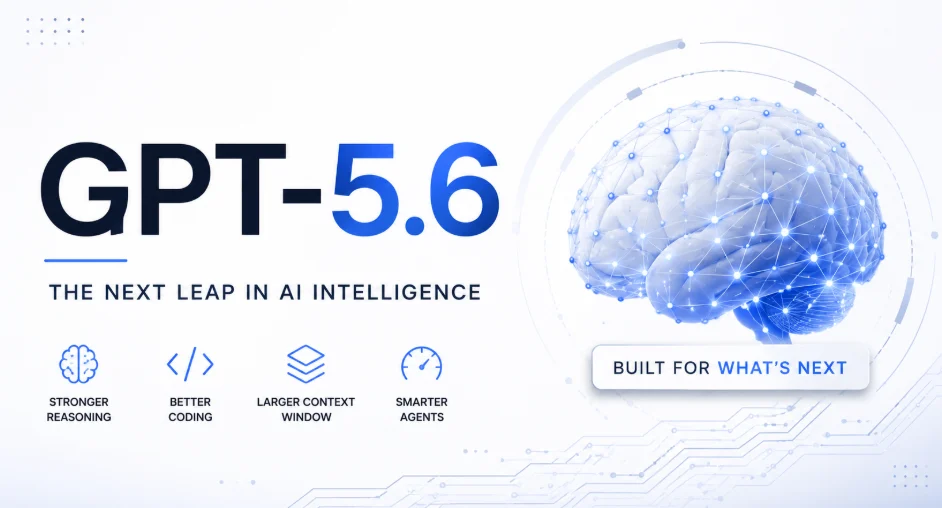
The AI industry is once again focused on OpenAI as growing discussion surrounding the GPT-5.6 release continues to dominate conversations among developers, businesses, and technology analysts. While OpenAI has not yet published a full official launch announcement or detailed model card for GPT-5.6, multiple reports, developer observations, and industry leaks have fueled widespread speculation about what could become the company’s next major language model upgrade.
The attention surrounding GPT-5.6 comes at a critical moment in the artificial intelligence race. Competitors including Anthropic and Google continue to push advancements in reasoning, coding, agentic workflows, and long-context processing. Against that backdrop, expectations are high that OpenAI’s next-generation model could introduce meaningful improvements across several key performance categories.
This article examines the latest verified developments, reported features, benchmark discussions, and why GPT-5.6 is attracting so much attention across the AI ecosystem.
Why GPT-5.6 Is Making Headlines
Interest in GPT-5.6 accelerated after references to the model reportedly appeared in backend systems connected to OpenAI’s development infrastructure. Several developers reported seeing GPT-5.6 identifiers within Codex-related environments before those references disappeared, suggesting internal testing activity. However, OpenAI has not officially confirmed specifications, benchmark scores, pricing, or release timing.
Industry observers note that OpenAI has followed a rapid iteration cycle throughout 2026, making speculation about another model release unsurprising. Reports indicate that GPT-5.6 is undergoing late-stage testing and may represent an incremental but meaningful upgrade over GPT-5.5 rather than a completely new model architecture.
The excitement reflects a broader trend in the AI market. Organizations increasingly evaluate language models based not only on conversational quality but also on coding performance, reasoning capabilities, autonomous task completion, multimodal understanding, and enterprise deployment efficiency.
What Is Officially Confirmed So Far?
One of the most important facts surrounding GPT-5.6 is that many widely circulated specifications remain unconfirmed.
As of late June 2026, OpenAI has not publicly released:
- An official GPT-5.6 model card
- Verified benchmark results
- Final pricing information
- Context window specifications
- Availability details for developers or enterprises
Multiple technology publications have emphasized that any detailed claims regarding benchmark scores or technical specifications should currently be treated with caution until OpenAI provides official documentation.
What has emerged, however, is evidence suggesting that GPT-5.6 exists within OpenAI’s internal testing environment and is progressing toward broader deployment.
Reports Suggest Stronger Reasoning Capabilities
One of the most discussed aspects of GPT-5.6 involves reasoning performance.
According to reports citing internal communications, OpenAI Chief Scientist Jakub Pachocki reportedly described GPT-5.6 as a “meaningful improvement” over GPT-5.5. While specific benchmark numbers have not been released, the statement has fueled expectations that reasoning improvements are among the model’s primary objectives.
Reasoning capabilities have become a major battleground among leading AI companies. Enterprises increasingly demand models capable of handling complex workflows, multi-step analysis, research tasks, software development, and decision support systems.
If GPT-5.6 delivers measurable improvements in these areas, it could strengthen OpenAI’s position in enterprise AI deployments where accuracy and reliability often matter more than conversational creativity.
Long-Context Processing Could See Significant Expansion
Another major topic generating discussion is the possibility of expanded context windows.
Several reports have suggested that GPT-5.6 may support substantially larger context capacities than previous versions. Some unofficial sources have referenced context windows approaching 1.5 million tokens, although OpenAI has not verified these claims.
If such improvements materialize, they could have major implications for:
- Legal document analysis
- Large-scale codebase management
- Research projects
- Enterprise knowledge systems
- Long-form content generation
- Financial document review
Large context windows allow AI systems to retain and analyze far greater amounts of information within a single interaction, reducing the need for repeated prompts and fragmented workflows.
However, experts caution that context size alone does not guarantee better performance. Real-world effectiveness depends on how accurately a model can retrieve and reason over information throughout the entire context window.
Coding and Software Development Improvements
Software development remains one of the most commercially valuable AI applications, making coding benchmarks particularly important.
Reports from developer communities suggest GPT-5.6 testing has focused heavily on programming-related tasks, autonomous workflows, and code generation. Discussions surrounding leaked checkpoints have repeatedly highlighted improvements in software engineering performance and frontend development capabilities.
For developers, potential improvements may include:
- More accurate code generation
- Better debugging assistance
- Enhanced codebase understanding
- Improved agent-driven development
- Stronger UI and frontend generation
- More reliable tool usage
These enhancements would align with broader industry trends as AI coding assistants become increasingly integrated into professional software development environments.
The competition in this area remains intense, with AI vendors racing to build systems capable of handling increasingly complex engineering tasks with minimal human intervention.
Growing Focus on AI Agents
Perhaps the most significant trend influencing GPT-5.6 expectations is the rise of AI agents.
The industry is rapidly moving beyond simple chatbots toward systems capable of completing multi-step tasks autonomously. Businesses increasingly seek AI solutions that can perform research, manage workflows, analyze data, write code, and interact with software tools independently.
Multiple reports suggest GPT-5.6 may continue OpenAI’s broader emphasis on agentic workflows and autonomous task completion.
This shift could have far-reaching implications across industries including:
- Customer service
- Marketing automation
- Software development
- Data analysis
- Business operations
- Knowledge management
As organizations pursue productivity gains, agent-based AI systems are expected to become a major area of investment throughout 2026 and beyond.
Vision and Multimodal Upgrades
Another area attracting attention involves multimodal AI capabilities.
Unconfirmed reports from developers testing internal checkpoints suggest GPT-5.6 may offer stronger image understanding and improved visual generation performance compared to previous GPT-5.x models. In particular, some reports point to improvements in SVG generation and visual reasoning tasks.
Multimodal capabilities are increasingly important because modern AI systems must process information across multiple formats, including:
- Text
- Images
- Documents
- Diagrams
- Screenshots
- User interfaces
Businesses adopting AI tools often require models capable of interpreting visual content alongside traditional text inputs. Improvements in this area could expand GPT-5.6’s usefulness across design, engineering, education, and enterprise productivity applications.
Enterprise Impact and Business Adoption
The significance of GPT-5.6 extends beyond technical benchmarks.
For businesses, every major AI model release influences strategic planning, software investments, and operational efficiency initiatives.
Companies evaluating AI deployments typically focus on several key questions:
Can the model reduce costs?
Efficiency improvements can lower API expenses and reduce infrastructure requirements. Some reports suggest GPT-5.6 may improve token efficiency, potentially reducing operational costs for organizations processing large volumes of AI requests.
Can it automate more work?
Enhanced reasoning and agent capabilities could enable organizations to automate increasingly sophisticated tasks.
Is it reliable enough for enterprise use?
Businesses require consistency, predictability, and security. Improvements in reasoning accuracy often have a direct impact on enterprise adoption.
Does it improve employee productivity?
Many organizations now evaluate AI systems primarily through productivity metrics. Better coding, research, and workflow automation capabilities can directly affect workforce efficiency.
These considerations help explain why each OpenAI model update receives significant attention from business leaders and technology decision-makers.
The Competitive Landscape
GPT-5.6 is emerging during one of the most competitive periods in AI history.
The market is increasingly shaped by competition among major technology companies pursuing leadership in:
- Reasoning models
- Coding assistants
- Agentic systems
- Long-context processing
- Enterprise AI platforms
Organizations are no longer evaluating AI models based solely on chatbot performance. Instead, they compare systems across practical business outcomes such as software development productivity, research accuracy, workflow automation, and operational efficiency.
This competitive pressure creates strong incentives for OpenAI to continue delivering measurable improvements with each model iteration.
For users, the result is rapid innovation and increasingly capable AI systems.
What Developers Are Watching Most Closely
As GPT-5.6 approaches broader availability, developers are paying particular attention to several metrics.
These include:
Reasoning Benchmarks
Can the model solve complex problems more accurately than GPT-5.5?
Coding Performance
Does it generate better software and reduce debugging requirements?
Context Retention
Can it effectively manage extremely large information sets?
Tool Integration
How well does it interact with external applications and workflows?
Speed and Cost
Are performance gains achieved without significantly increasing operational expenses?
These questions will likely remain unanswered until OpenAI releases official technical documentation and independent benchmarking becomes available.
Industry Expectations for the Coming Months
The broader AI industry increasingly views frontier models as productivity infrastructure rather than experimental technology.
This shift means that every major release is evaluated through a business lens. Organizations want to know whether new models can:
- Improve customer experiences
- Accelerate software development
- Reduce operational costs
- Enable new products and services
- Increase workforce productivity
GPT-5.6 arrives at a moment when demand for these capabilities continues to grow rapidly.
Even incremental improvements can have significant economic implications when deployed across millions of users and thousands of organizations worldwide.
Looking Ahead
The GPT-5.6 release has become one of the most closely watched developments in artificial intelligence. Although many circulating specifications remain unverified, the growing volume of reports, testing activity, and industry discussion indicates that OpenAI’s next model update is generating substantial anticipation.
What appears increasingly clear is that OpenAI’s strategic focus remains centered on stronger reasoning, advanced coding capabilities, expanded context handling, multimodal intelligence, and agent-driven workflows. These areas align directly with the evolving needs of businesses, developers, and enterprise customers.
Until official benchmark data and technical documentation are released, caution remains warranted when evaluating leaked specifications. Nevertheless, GPT-5.6 has already succeeded in capturing industry attention, highlighting the continued importance of OpenAI’s model roadmap in shaping the future of artificial intelligence.
As the AI race accelerates, the eventual release of GPT-5.6 could offer an important glimpse into the next generation of intelligent systems—one where reasoning, autonomy, and real-world productivity become the defining measures of progress.