
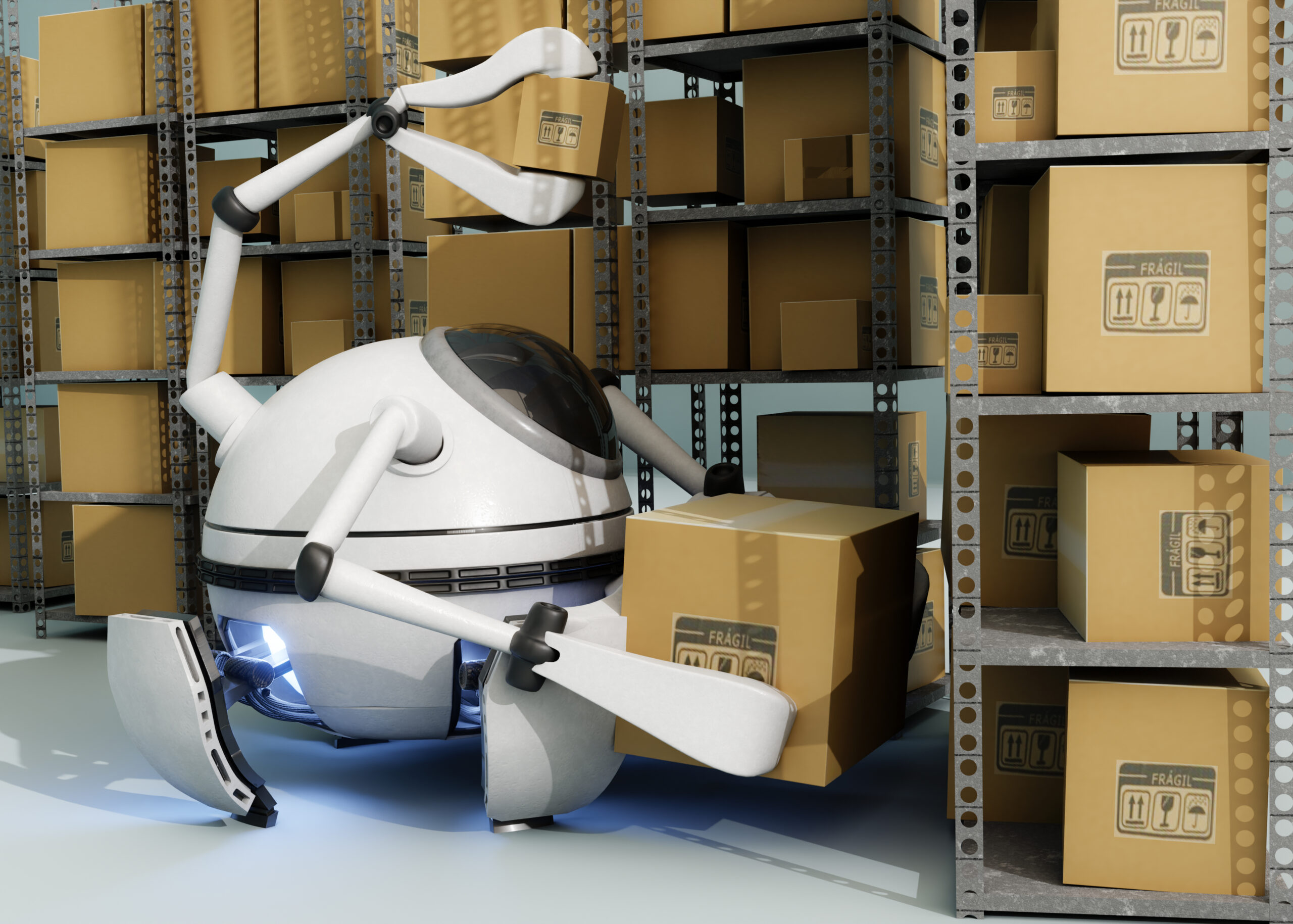
Amazon has taken another significant step toward transforming warehouse operations through artificial intelligence and robotics. During its recent “Delivering the Future” event in the United Kingdom, the company unveiled a new generation of intelligent warehouse robots designed to improve fulfillment speed, workplace safety, and operational efficiency across its global logistics network.
The announcement highlights Amazon’s continued investment in automation as demand for faster deliveries grows worldwide. Rather than introducing a single robotic system, the company showcased multiple AI-powered innovations, including an upgraded version of its autonomous Proteus mobile robot, the tactile-enabled Vulcan robotic arm, and the STARK automated tote-handling system. Together, these technologies represent one of Amazon’s most ambitious warehouse modernization efforts to date.
For businesses, investors, and the broader robotics industry, these developments reinforce Amazon’s position as one of the world’s leading adopters of industrial artificial intelligence.
Amazon Expands Its AI Robotics Strategy
Warehouse automation has long been central to Amazon’s logistics operations. Since acquiring Kiva Systems more than a decade ago, the company has steadily integrated robotics into fulfillment centers worldwide.
The latest announcements demonstrate that Amazon’s focus has shifted beyond simple automation toward AI-driven decision making. Instead of merely transporting inventory, newer robotic systems can understand instructions, prioritize work, navigate complex warehouse environments, and collaborate more naturally with human employees.
The company also announced a €10 billion investment in expanding and modernizing its European fulfillment network, with robotics playing a major role in future warehouse operations. The investment supports new fulfillment centers, improved delivery infrastructure, and broader deployment of AI-powered warehouse technologies.
This investment signals that robotics is no longer viewed as an experimental technology but as core infrastructure supporting Amazon’s long-term logistics strategy.
Next-Generation Proteus Brings Conversational AI to Warehouse Robots
Among the biggest announcements was Amazon’s upgraded Proteus autonomous mobile robot.
Earlier versions of Proteus primarily transported heavy carts within designated dock areas inside fulfillment centers. The latest version dramatically expands those capabilities by incorporating advanced AI that enables warehouse employees to communicate with the robot using natural language.
Instead of programming detailed commands, workers can issue conversational instructions. The robot then determines which task should be completed first, plans the safest route, and executes the assignment autonomously.
This represents a notable shift in industrial robotics.
Traditional warehouse robots typically rely on predefined workflows and structured programming. Amazon’s latest system combines robotics with generative AI and intelligent planning, reducing the complexity of managing warehouse automation while making collaboration between humans and machines more intuitive.
The upgraded Proteus also operates across larger portions of fulfillment centers rather than remaining confined to specific operational zones, allowing greater flexibility in moving inventory throughout warehouse facilities.
Vulcan Gives Robots a Sense of Touch
Another major advancement comes from Vulcan, Amazon’s robotic system equipped with tactile sensing capabilities.
Unlike conventional robotic arms that rely mainly on cameras and programmed positioning, Vulcan can detect physical contact and adjust its grip accordingly.
This “sense of touch” allows the robot to safely handle products stored closely together on warehouse shelves while minimizing damage to inventory.
Handling objects with varying sizes, shapes, packaging materials, and fragility has traditionally been one of the biggest technical challenges in warehouse robotics.
Vulcan’s AI combines computer vision with force sensing to estimate how much pressure should be applied during each pick, making robotic handling significantly more precise.
As Amazon expands product categories across millions of stock-keeping units (SKUs), improvements in robotic manipulation become increasingly valuable for maintaining speed without sacrificing product quality.
STARK Streamlines Internal Warehouse Logistics
Amazon also introduced STARK, a collaborative robotic tote-handling system initially tested in Barcelona.
Instead of focusing on individual item picking, STARK automates the transportation of inventory containers between warehouse workstations.
The system reduces unnecessary employee walking distances while improving inventory flow across fulfillment centers.
Amazon plans to deploy STARK across 15 European facilities by 2027, making it another important component of the company’s broader automation strategy.
While less visible than humanoid robots often featured in technology demonstrations, systems like STARK can significantly improve warehouse productivity by optimizing thousands of repetitive movements every hour.
AI Is Becoming the Brain Behind Warehouse Automation
One of the most significant aspects of Amazon’s latest robotics announcements is the increasing role artificial intelligence in decision-making.
Previous warehouse robots generally performed isolated tasks:
- Moving inventory
- Lifting containers
- Sorting packages
- Delivering shelves
The newest generation performs these physical actions while simultaneously making operational decisions.
AI systems determine task priorities based on warehouse demand.
Navigation software continuously identifies efficient travel routes.
Computer vision recognizes warehouse layouts.
Natural language processing enables easier interaction with employees.
Together, these technologies transform warehouse robots from automated machines into intelligent operational assistants.
This convergence of robotics and AI represents one of the fastest-growing areas within enterprise technology. For more related Ai insight
Why Amazon’s Robotics Expansion Matters
Amazon ships billions of products annually.
Even small improvements in warehouse efficiency can produce enormous financial savings while reducing delivery times for customers.
Several strategic benefits emerge from expanded robotics adoption.
Higher productivity
Autonomous robots can work continuously while reducing repetitive manual transportation tasks.
Improved workplace safety
Heavy lifting, repetitive reaching, and long walking distances contribute to warehouse injuries. Robots increasingly perform these physically demanding activities, allowing employees to focus on supervision and exception handling.
Greater scalability
During seasonal shopping peaks, automated systems help warehouses process substantially higher order volumes without proportional increases in staffing requirements.
Operational consistency
AI-powered robots perform standardized workflows with consistent accuracy, reducing variability across fulfillment centers.
These improvements strengthen Amazon’s ability to compete in an increasingly demanding e-commerce market where same-day and next-day delivery have become customer expectations rather than premium services.
Workforce Transformation: How Robotics Is Changing Warehouse Jobs
One of the most closely watched aspects of Amazon’s robotics strategy is its effect on employees. While automation often raises concerns about job displacement, Amazon maintains that its robotics initiatives are intended to complement human workers rather than replace them entirely.
Modern fulfillment centers require employees to perform a wide range of tasks that involve decision-making, quality control, equipment monitoring, maintenance, and customer-focused problem solving. AI-powered robots are increasingly taking over repetitive, physically demanding, or hazardous tasks, allowing employees to focus on work that benefits from human judgment and adaptability.
The company has also expanded training programs designed to help workers develop technical skills related to robotics operations, maintenance, and automation systems. As warehouses become more technologically advanced, demand is expected to grow for technicians, robotics engineers, AI specialists, and operations managers who can oversee these intelligent systems.
Industry analysts generally agree that warehouse employment is evolving rather than disappearing. While some manual roles may decline over time, new positions requiring digital and technical expertise are likely to emerge.
Amazon’s Competitive Position in Warehouse Robotics
Amazon’s latest announcements further strengthen its leadership in warehouse automation, but competition remains intense. Retailers and logistics providers worldwide are investing heavily in robotics to improve efficiency and meet rising customer expectations.
The following comparison highlights how Amazon’s strategy differs from other major players.
| Company | Robotics Focus | Primary Goal |
|---|---|---|
| Amazon | AI-powered fulfillment robots, autonomous mobile robots, robotic manipulation | Faster order fulfillment, lower operating costs, improved safety |
| Walmart | Automated distribution centers and inventory systems | Supply chain optimization and inventory accuracy |
| DHL | Warehouse automation and collaborative robotics | Logistics efficiency and package handling |
| Ocado | Robotic grocery fulfillment systems | High-speed online grocery processing |
| Alibaba | Smart logistics and autonomous warehouse technology | Scalable e-commerce fulfillment |
Amazon’s advantage lies in the scale of its operations. With hundreds of fulfillment centers serving customers around the world, even incremental improvements in robotic efficiency can translate into substantial cost savings and faster deliveries.
The Growing Role of Generative AI in Robotics
A defining feature of Amazon’s newest warehouse technologies is the integration of generative AI.
Traditional warehouse automation relies on predefined rules. Robots follow programmed instructions and repeat the same sequence of actions. Generative AI changes this model by enabling robots to interpret natural language, adapt to changing environments, and make decisions based on real-time information.
For example, an employee may simply instruct a robot to prioritize a group of urgent orders. Instead of requiring detailed programming, the AI system interprets the request, evaluates warehouse conditions, selects an optimal route, and completes the task autonomously.
This capability reduces operational complexity while making robotics more accessible to warehouse staff who may not have technical programming expertise.
As large language models continue to improve, industry experts expect conversational interfaces to become increasingly common in industrial environments.
Benefits for Businesses Beyond Amazon
Although Amazon develops many of its robotics technologies for internal use, its innovations often influence the broader logistics industry.
Warehouse operators across manufacturing, retail, healthcare, pharmaceuticals, and third-party logistics companies closely monitor Amazon’s automation strategies.
Several broader business trends are becoming clear.
Faster Order Processing
AI-powered robotics can reduce delays associated with manual transportation, inventory retrieval, and sorting. Faster internal operations contribute directly to shorter delivery times.
Improved Inventory Accuracy
Computer vision and intelligent robotics reduce errors during picking, storing, and transporting products. Better inventory accuracy lowers operational costs while improving customer satisfaction.
Lower Long-Term Operating Costs
Although robotics requires significant upfront investment, automated systems can improve productivity over many years by reducing repetitive labor costs and minimizing operational inefficiencies.
Enhanced Workplace Safety
Robots increasingly handle heavy lifting, repetitive movement, and physically demanding transportation tasks, helping reduce workplace injuries and employee fatigue.
Greater Supply Chain Resilience
Automated warehouses can continue operating efficiently during labor shortages, seasonal demand spikes, or unexpected disruptions.
Challenges That Still Remain
Despite rapid progress, warehouse robotics continues to face important technical and operational challenges.
High Capital Investment
Deploying advanced robotics across large fulfillment networks requires billions of dollars in infrastructure, hardware, software, and employee training.
Smaller retailers may struggle to justify similar investments without achieving sufficient operational scale.
Complex System Integration
Modern fulfillment centers combine robotics, AI software, inventory management systems, transportation networks, and cloud computing platforms.
Integrating these systems while maintaining uninterrupted operations requires significant engineering expertise.
Maintenance Requirements
Warehouse robots operate continuously in demanding environments.
Preventive maintenance, software updates, sensor calibration, and hardware repairs remain essential to maintaining productivity.
Workforce Adaptation
Employees must learn to work alongside increasingly intelligent machines.
Companies investing in automation must also invest in workforce training to ensure successful collaboration between humans and AI systems.
Expert Perspective
Technology analysts view Amazon’s latest robotics announcements as part of a broader transformation occurring across enterprise AI.
Rather than focusing solely on chatbots or generative AI assistants, businesses are increasingly applying AI to physical operations.
This convergence of robotics, computer vision, machine learning, and autonomous decision-making has the potential to reshape logistics in much the same way cloud computing transformed enterprise software over the past two decades.
Industry observers also note that Amazon’s approach emphasizes practical deployment rather than experimental demonstrations. Instead of showcasing futuristic concepts, the company continues to introduce systems designed for immediate use inside operational fulfillment centers.
This practical focus may accelerate industry-wide adoption as competing logistics providers seek similar productivity improvements.
What This Means for Consumers
Although customers may never directly interact with Amazon’s warehouse robots, the technology can have meaningful effects on the shopping experience.
Potential consumer benefits include:
- Faster order fulfillment.
- More consistent delivery estimates.
- Improved product availability.
- Fewer fulfillment errors.
- Better inventory management during peak shopping seasons.
As robotics becomes more capable, consumers may also see continued expansion of same-day and next-day delivery services in additional markets.
Looking Ahead: The Future of AI Warehouse Robotics
Amazon’s latest announcements suggest that warehouse automation is entering a new phase.
Future robotics systems are expected to become increasingly collaborative, intelligent, and adaptable. Instead of performing isolated tasks, AI-powered robots will likely coordinate with one another, communicate naturally with employees, and continuously optimize warehouse operations using real-time data.
Several trends are expected to shape the next generation of warehouse automation:
- Greater use of multimodal AI for vision, language, and planning.
- More autonomous inventory movement throughout fulfillment centers.
- Improved robotic manipulation for fragile and irregular products.
- Expanded predictive maintenance using AI analytics.
- Increased collaboration between human workers and intelligent robotic systems.
- Wider adoption of cloud-connected robotics platforms across global logistics networks.
As AI models continue advancing, warehouse robots may become capable of handling increasingly complex workflows with minimal human intervention while still operating safely alongside employees.
Frequently Asked Questions
What are Amazon warehouse robots?
Amazon warehouse robots are AI-powered automated systems that transport inventory, retrieve products, sort packages, and assist employees inside fulfillment centers. The company uses multiple robotic platforms designed for different warehouse tasks.
What is Proteus?
Proteus is Amazon’s autonomous mobile robot that transports inventory throughout fulfillment centers. The newest version incorporates advanced AI capabilities, allowing employees to interact with it using natural language while the robot independently plans and executes tasks.
What is Vulcan?
Vulcan is Amazon’s robotic manipulation system equipped with tactile sensing technology. Unlike conventional robotic arms, Vulcan can detect physical contact and adjust its grip when handling products, improving accuracy while reducing the risk of damage.
Will Amazon robots replace warehouse workers?
Current evidence suggests that Amazon is using robotics primarily to automate repetitive and physically demanding tasks while employees continue performing supervision, maintenance, quality control, and decision-making roles. Workforce responsibilities are expected to evolve as automation expands.
Why is AI important for warehouse robotics?
Artificial intelligence enables robots to make decisions, recognize warehouse environments, interpret natural language instructions, optimize travel routes, and adapt to changing operational conditions. These capabilities make warehouse automation more flexible and efficient than traditional rule-based systems.
Final Thoughts
Amazon’s latest warehouse robotics announcements demonstrate that artificial intelligence is becoming a foundational technology for modern logistics. By combining autonomous mobile robots, tactile robotic arms, conversational AI, and intelligent warehouse management systems, the company is moving beyond conventional automation toward a more adaptive and data-driven fulfillment network.
The introduction of advanced systems such as Proteus, Vulcan, and STARK reflects a broader industry shift in which AI is no longer limited to software applications but is increasingly embedded in physical operations. For Amazon, this means faster order processing, improved workplace safety, and greater operational efficiency. For the wider logistics industry, it sets a benchmark that competitors will likely strive to match.
Looking ahead, warehouse robotics will continue to evolve alongside advances in generative AI, computer vision, and autonomous decision-making. Organizations that successfully integrate these technologies while investing in workforce development will be better positioned to build resilient, scalable, and customer-focused supply chains. As the technology matures, AI-powered robotics is expected to become a defining feature of the next generation of global commerce.