
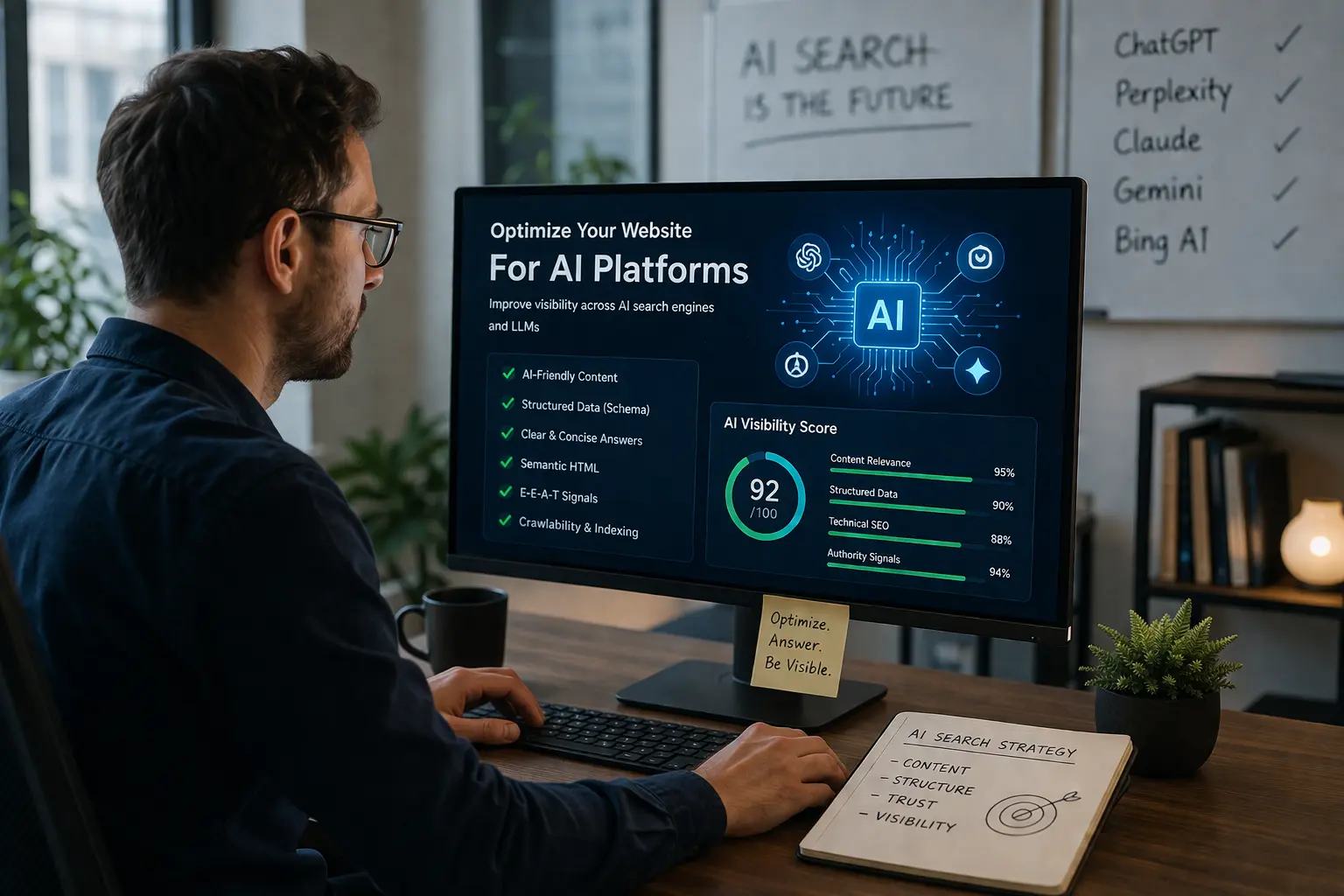
Search is changing.
People are no longer relying only on traditional Google results to find information. They are increasingly asking AI-powered search systems questions and expecting direct, useful answers.
Google now has AI Overviews and AI Mode, while platforms such as ChatGPT and Claude can use web information to answer current questions. Google says its AI search experiences can use multiple related searches, sometimes called query fan-out, to explore different aspects of a question and identify supporting web pages.
This creates a major opportunity for website owners.
But there is an important misconception: optimizing for AI search does not mean abandoning traditional SEO.
Google’s current guidance says the same fundamental SEO practices remain important for AI features. Your pages still need to be crawlable, indexable, useful, technically sound, and valuable to real people.
So, how do you optimize your website for AI search in 2026?
In this guide, you will learn how to make your website easier for AI-powered search systems to understand, trust, retrieve, and potentially cite.
What Is AI Search Optimization?
AI search optimization is the process of improving your website so that AI-powered search experiences can better understand and use your content when answering users’ questions.
It overlaps heavily with SEO, but the way users search is changing.
Traditional search might look like:
“best AI writing tools”
AI search might look more like:
“What is the best AI writing tool for a beginner blogger with a small budget?”
The second query is longer, more conversational, and contains more context.
AI systems need to understand:
- What your page is about
- Which question it answers
- Whether the information is trustworthy
- How the information relates to other topics
- Whether your content provides enough useful context
Google’s official guidance makes clear that there is no special AI markup or secret optimization required to appear in AI Overviews or AI Mode. Your existing SEO foundation remains critical.
Why AI Search Matters in 2026
AI search can change how people discover websites.
Instead of simply displaying a list of ten blue links, AI-powered experiences can summarize information and provide links to supporting websites.
Google says AI Overviews and AI Mode are designed to help users explore complex questions and discover a broader range of useful websites.
That means website owners should focus on becoming a useful source, rather than simply trying to rank for one keyword.
For bloggers and small businesses, this can create opportunities to attract visitors who have specific problems and stronger intent.
For example, a website publishing an in-depth article about “AI workflow automation” could potentially be discovered for questions such as:
- What is AI workflow automation?
- How does AI automation work?
- What tools can automate marketing?
- Is AI workflow automation suitable for small businesses?
- How much does AI automation cost?
The goal is to build content that answers the topic comprehensively.
7 Powerful Ways to Optimize Your Website for AI Search in 2026
1. Create Helpful, Original Content
This is the most important strategy.
Do not create content simply because an AI tool can produce it quickly.
Google specifically warns that generating large numbers of pages with generative AI without adding value can violate its spam policies.
Instead, add something useful that competing pages do not provide.
Add original value
You can make content more useful by including:
- Your own analysis
- Real examples
- Original comparisons
- Practical steps
- First-hand observations
- Screenshots where appropriate
- Data and calculations
- Expert explanations
- Clear pros and cons
- Updated information
For example, instead of writing:
“AI tools can save businesses time.”
Explain how they save time.
Show a realistic workflow:
- A customer submits a form.
- AI analyzes the inquiry.
- The lead is categorized.
- A personalized response is generated.
- The CRM is updated.
- A team member receives a notification.
Specific information gives your content more practical value.
2. Answer Questions Clearly and Directly
AI search systems need to identify useful information quickly.
Make important answers easy to find.
A strong structure is:
Question
What is AI search optimization?
Direct answer
AI search optimization is the process of improving website content and technical SEO so AI-powered search systems can understand, retrieve, and potentially reference the site’s information.
Then expand on the answer.
This format can help both traditional searchers and AI systems understand your page.
Use question-based headings
Consider headings such as:
- What is AI search optimization?
- How does AI search work?
- How can I optimize my website for AI search?
- Does traditional SEO still matter?
- Does schema markup help AI search?
- How do I measure AI search visibility?
These questions also align naturally with conversational searches.
3. Build Topic Authority Instead of Publishing Random Articles
One of the biggest mistakes smaller websites make is publishing unrelated content.
If your website focuses on AI, create connected content around important AI topics.
For example, a topic cluster could look like this:
| Pillar Topic | Supporting Content |
|---|---|
| AI Tools | Best AI tools for bloggers |
| AI SEO | How to optimize content for AI search |
| AI Marketing | AI in digital marketing |
| AI Automation | AI workflow automation software |
| AI Business | AI tools for small businesses |
Your existing Thinking Era Hub content already provides opportunities for this approach. For example, your articles about AI workflow automation software, AI in digital marketing, and keyword research tools can form part of a connected content ecosystem.
Instead of treating every article as an isolated page, connect related articles with contextual internal links.
This helps readers discover more information and helps search engines understand relationships between your pages.
4. Strengthen Internal Linking
Internal links are especially important for websites trying to build topical authority.
Google’s AI search documentation specifically recommends making content easily discoverable through internal links.
For example, if you write about AI search optimization, you could naturally link to your existing article about AI workflow automation software when discussing AI-powered marketing workflows.
You can also connect the topic to your article about AI in digital marketing when discussing how AI is changing marketing strategies. Your site already publishes content in these related areas.
Use descriptive anchor text
Weak:
Click here.
Better:
Learn more about AI workflow automation software.
The second anchor gives readers and search engines more context.
5. Improve Technical SEO
Excellent content cannot perform well if search engines cannot properly access it.
Before worrying about advanced AI optimization, make sure your technical foundation is healthy.
Check these areas
Crawlability
Make sure important pages are not accidentally blocked by robots.txt or other controls.
Indexing
Use Google Search Console to confirm that important pages can be indexed.
Mobile usability
Your website should work properly on smartphones and tablets.
Page experience
Improve loading performance, layout stability, and usability.
HTTPS
Use a secure HTTPS connection across your website.
Internal links
Make important pages accessible through relevant links.
Text availability
Important information should be available as readable HTML text rather than being hidden inside images or inaccessible elements.
Google’s guidance confirms that pages need to meet normal Search technical requirements to be eligible for AI Overviews and AI Mode.
6. Use Structured Data Correctly
Structured data can help search engines understand the meaning and type of information on a page.
However, do not fall for the idea that you need a special “AI schema.”
Google explicitly says there is no special schema.org structured data required for AI Overviews or AI Mode.
Instead, use relevant structured data correctly when appropriate.
Examples include:
- Article
- Breadcrumb
- Organization
- Product
- LocalBusiness
- FAQ-related structured data where eligible and appropriate
Most importantly, make sure your structured data accurately represents visible content.
Do not add markup for information that users cannot actually find on the page.
7. Demonstrate Expertise and Trust
AI search systems need reliable information.
Your website should make it easier for readers to understand who created the content and why they should trust it.
Strengthen your website’s trust signals
Consider adding:
- Author names
- Author bios
- About page
- Contact page
- Editorial information
- Sources and references
- Updated dates when appropriate
- Clear correction policies
- Original research
- Transparent product reviews
For AI-related topics, freshness matters too.
An article about AI tools from 2023 may contain outdated information in 2026.
Review important articles regularly.
Update:
- Tool names
- Features
- Pricing
- Screenshots
- Statistics
- Product availability
- Links
- Examples
How to Write Content AI Search Can Understand
Use Clear Content Structure
Avoid turning your article into one enormous block of text.
Instead, use:
- Short paragraphs
- Descriptive headings
- Bullet points
- Numbered steps
- Tables
- Definitions
- Examples
- FAQs
This improves readability while making the relationships between different sections clearer.
Cover the Topic From Multiple Angles
Suppose your primary keyword is:
AI search optimization
Do not repeat that phrase dozens of times.
Instead, naturally cover related concepts such as:
- AI SEO
- generative search
- AI Overviews
- AI Mode
- conversational search
- answer engine optimization
- generative engine optimization
- topical authority
- semantic SEO
- structured data
- entity optimization
- internal linking
- content quality
- search intent
These related concepts provide context without keyword stuffing.
Optimize for Long-Tail and Conversational Searches
People often use longer questions when interacting with AI.
Instead of targeting only:
AI SEO
also create content that addresses questions such as:
- How do I optimize my website for AI search?
- How can my blog appear in Google AI Overviews?
- Does SEO still matter for AI search?
- How do I make content easier for AI search engines to understand?
- What is the difference between SEO and AI search optimization?
You do not necessarily need a separate article for every question.
A comprehensive guide can answer several closely related questions.
Optimize for Entities, Not Just Keywords
Modern search systems understand concepts and relationships.
For example, if you publish an article about AI workflow automation, mentioning relevant concepts such as CRM systems, marketing automation, lead qualification, APIs, and business processes can provide useful context.
Think about the entities surrounding your topic.
For an article about AI search, relevant entities include:
- Google Search
- AI Overviews
- AI Mode
- ChatGPT
- Claude
- Search Console
- structured data
- robots.txt
- SEO
- generative AI
The objective is not to force these terms into your article.
Mention them only when they genuinely help explain the subject.
Make Your Content Easy to Cite
If you want your website to become a useful source for AI-generated answers, make important claims clear and support them appropriately.
For example:
Claim: Traditional SEO still matters for AI search.
Support: Google’s current documentation states that its generative AI search features rely on core Search ranking and quality systems, so established SEO fundamentals remain relevant.
This is much stronger than making unsupported claims.
For statistics, research findings, product specifications, and current developments, cite authoritative sources.
Do You Need Special AI Files or GEO Tools?
No special “AI.txt” file or secret schema is required to appear in Google AI Overviews or AI Mode.
Google explicitly says there are no additional technical requirements and no special AI files or structured data needed for these features.
That does not mean AI-focused SEO tools are useless.
Tools can help you:
- Find content gaps
- Analyze competitors
- Discover questions
- Monitor rankings
- Audit technical SEO
- Track mentions
- Improve content structure
But tools should support a strong strategy rather than replace it.
How to Measure AI Search Performance
AI search visibility should not be measured using rankings alone.
Track several metrics.
Google Search Console
Monitor:
- Impressions
- Clicks
- CTR
- Queries
- Pages
- Search performance
Google introduced dedicated generative-AI performance reporting in Search Console in June 2026 and began rolling the reports out to a subset of websites.
Availability may vary, so check your own Search Console account.
Google Analytics
Track:
- Organic sessions
- Engagement
- Conversions
- Revenue
- Landing pages
- Returning visitors
The real goal is not simply appearing in an AI answer.
The goal is attracting the right visitors and turning that visibility into useful business results.
SEO vs AI Search Optimization
| Factor | Traditional SEO | AI Search Optimization |
| Main goal | Improve search visibility | Improve visibility in AI-powered answers |
| Keywords | Very important | Still useful, but broader context matters |
| Content | Search-intent focused | Question and context focused |
| Internal links | Important | Important |
| Technical SEO | Essential | Essential |
| Authority | Important | Important |
| Structured data | Useful | Useful when appropriate |
| Original content | Important | Extremely important |
| Conversational queries | Useful | Highly relevant |
| User experience | Important | Important |
The key point is that these strategies are not competing systems.
AI search optimization is largely an extension of good SEO and high-quality content practices.
Common AI Search Optimization Mistakes
1. Publishing Hundreds of AI-Generated Articles
More content does not automatically mean more traffic.
Google warns against scaled content that exists primarily to manipulate rankings without providing meaningful value.
2. Keyword Stuffing
Repeating “AI search optimization” in every paragraph makes content unnatural.
Use the primary keyword naturally and cover related concepts.
3. Ignoring Search Intent
A page may target the correct keyword but still fail because it does not answer what users actually want.
Study the questions behind the search.
4. Publishing Outdated Information
AI changes rapidly.
Review important AI content regularly.
5. Weak Internal Linking
Do not leave valuable articles isolated.
Connect related pages naturally.
6. Chasing Every New GEO Trend
The AI search industry changes quickly.
Be careful with claims that a specific hack, file, markup, or tool guarantees AI visibility.
Google’s own 2026 guidance emphasizes foundational SEO rather than secret AI ranking tricks.
Pros and Cons of Optimizing for AI Search
Pros
- Expands your potential search visibility
- Supports long-tail queries
- Encourages better content structure
- Strengthens topical authority
- Improves user experience
- Can attract high-intent visitors
- Builds a stronger long-term SEO foundation
Cons
- AI search behavior is still evolving
- Visibility is not guaranteed
- Attribution can be harder to measure
- Some AI answers may satisfy users without a website click
- Constant content updates may be necessary
Cost Considerations
You do not need an expensive AI SEO platform to start.
Free or low-cost approach
A beginner can start with:
- Google Search Console
- Google Analytics
- Google Trends
- A basic keyword research tool
- WordPress
- A spreadsheet for content planning
Paid approach
More advanced websites may invest in:
- SEO platforms
- Content optimization software
- Technical SEO crawlers
- Rank tracking
- Analytics tools
- AI-assisted research tools
The best investment is usually not the tool itself.
It is the quality of the strategy and content you create with it.
Who Should Optimize for AI Search?
AI search optimization is especially useful for:
Bloggers
Build topical authority and attract people searching for detailed answers.
Content Creators
Turn expertise into searchable resources.
Small Businesses
Answer customer questions before competitors do.
SaaS Companies
Create educational content around problems their products solve.
Digital Marketers
Build organic visibility across changing search experiences.
Affiliate Websites
Create genuinely useful comparisons, tutorials, and buying guides rather than thin promotional pages.
A Practical 30-Day AI Search Optimization Plan
If your website needs a simple starting point, follow this process.
Week 1: Technical Foundation
- Check Google Search Console.
- Fix important indexing issues.
- Review robots.txt.
- Check broken links.
- Improve slow pages.
- Confirm mobile usability.
- Review your sitemap.
Week 2: Content Audit
Choose your 10–20 most important articles.
For each article, ask:
- Does it answer the main question?
- Is the information current?
- Does it provide original value?
- Are the headings clear?
- Are there useful examples?
- Are sources cited?
- Are related articles linked?
Week 3: Build Topic Clusters
Choose 2–4 important topics for your website.
Create supporting articles around each topic and connect them with contextual internal links.
Week 4: Improve and Measure
Track:
- Search impressions
- Clicks
- CTR
- Rankings
- Organic traffic
- Conversions
Then improve pages based on actual performance.
Pro Tips for AI Search in 2026
Tip 1: Write for humans first
If readers find your content useful, you are already moving in the right direction.
Tip 2: Put the answer near the top
Do not make readers search through 2,000 words to find a simple definition.
Tip 3: Add original information
Your own analysis can make a page more valuable than another generic AI-generated article.
Tip 4: Build content clusters
One strong topic cluster can be more useful than dozens of unrelated posts.
Tip 5: Keep important content updated
Especially for AI tools, software, pricing, and rapidly changing technologies.
Tip 6: Use internal links strategically
Connect related pages using natural, descriptive anchor text.
Tip 7: Do not chase shortcuts
There is no guaranteed trick that makes Google or another AI system cite your website.
Build a site worth citing.
Final Verdict
Optimizing your website for AI search in 2026 is less about finding a secret AI SEO hack and more about becoming a trusted, useful, technically accessible source of information.
The strongest strategy combines:
- Helpful original content
- Clear answers
- Strong topical authority
- Internal linking
- Technical SEO
- Appropriate structured data
- Reliable sources
- Regular content updates
- Good user experience
Google’s latest guidance reinforces this approach: existing SEO fundamentals remain the foundation for visibility in AI Overviews and AI Mode.
For a growing website such as Thinking Era Hub, the best move is therefore not to publish content as quickly as possible.
Instead, build fewer, stronger, better-connected resources around your core AI topics.
Ready to make your website more visible in the changing search landscape?
Start today by auditing your most important pages, improving their answers, strengthening internal links, fixing technical SEO issues, and adding information that competitors do not provide.
Then monitor your results in Google Search Console and continue improving the pages that show the greatest potential.
You can also explore Google’s official guidance on generative AI search, along with trusted resources from major AI and SEO platforms, before making major changes to your website.
Conclusion
AI search is changing how people discover information, but the fundamentals have not disappeared.
Google’s current guidance confirms that traditional SEO remains important for AI Overviews and AI Mode. Pages still need to be accessible, indexable, useful, trustworthy, and relevant.
The biggest opportunity in 2026 is to create content that does more than repeat information already available online.
Answer real questions.
Provide original insights.
Connect related topics.
Support important claims.
Keep information fresh.
Make your website easy for both people and search systems to understand.
If you consistently follow these principles, optimizing your website for AI search in 2026 becomes part of a broader strategy for building a stronger website—not just chasing the latest search trend.
FAQ Section
1. How do I optimize my website for AI search in 2026?
Focus on the fundamentals: publish original helpful content, answer questions clearly, improve technical SEO, strengthen internal links, use appropriate structured data, demonstrate expertise, and keep important information updated. Google says its existing SEO best practices remain relevant to AI search features.
2. Does SEO still matter for AI search?
Yes. Google says AI Overviews and AI Mode rely on its existing Search ranking and quality systems, making traditional SEO fundamentals an important part of AI search visibility.
3. Do I need special AI schema to appear in Google AI Overviews?
No. Google says there is no special schema.org markup required for AI Overviews or AI Mode. Use appropriate structured data when it accurately represents the visible content on your page.
4. Does AI-generated content hurt SEO?
AI-generated content is not automatically harmful. However, Google warns that generating large amounts of content without adding value can violate its spam policies. The focus should be on helpful, original, people-first content.
5. What is the difference between SEO and AI search optimization?
Traditional SEO focuses on visibility in search results, while AI search optimization focuses on making content useful and understandable within AI-powered search experiences. In practice, they overlap heavily because AI search still relies on core search and quality systems.
6. How can I increase my chances of being cited by AI search engines?
Create authoritative, original content that directly answers user questions, provide evidence for important claims, maintain strong technical SEO, build topical authority, and make your pages easy to discover through internal links. There is no guaranteed method for getting cited.
7. Can small websites compete in AI search?
Yes. A small website can build visibility by focusing on a specific niche, developing strong topical authority, answering underserved questions, publishing original insights, and maintaining high-quality content instead of trying to cover everything.
8. How do I measure AI search visibility?
Start with Google Search Console and Analytics. Monitor impressions, clicks, queries, pages, organic traffic, engagement, and conversions. Google also began rolling out dedicated generative-AI performance reporting in Search Console in 2026, although availability is currently being expanded gradually.