
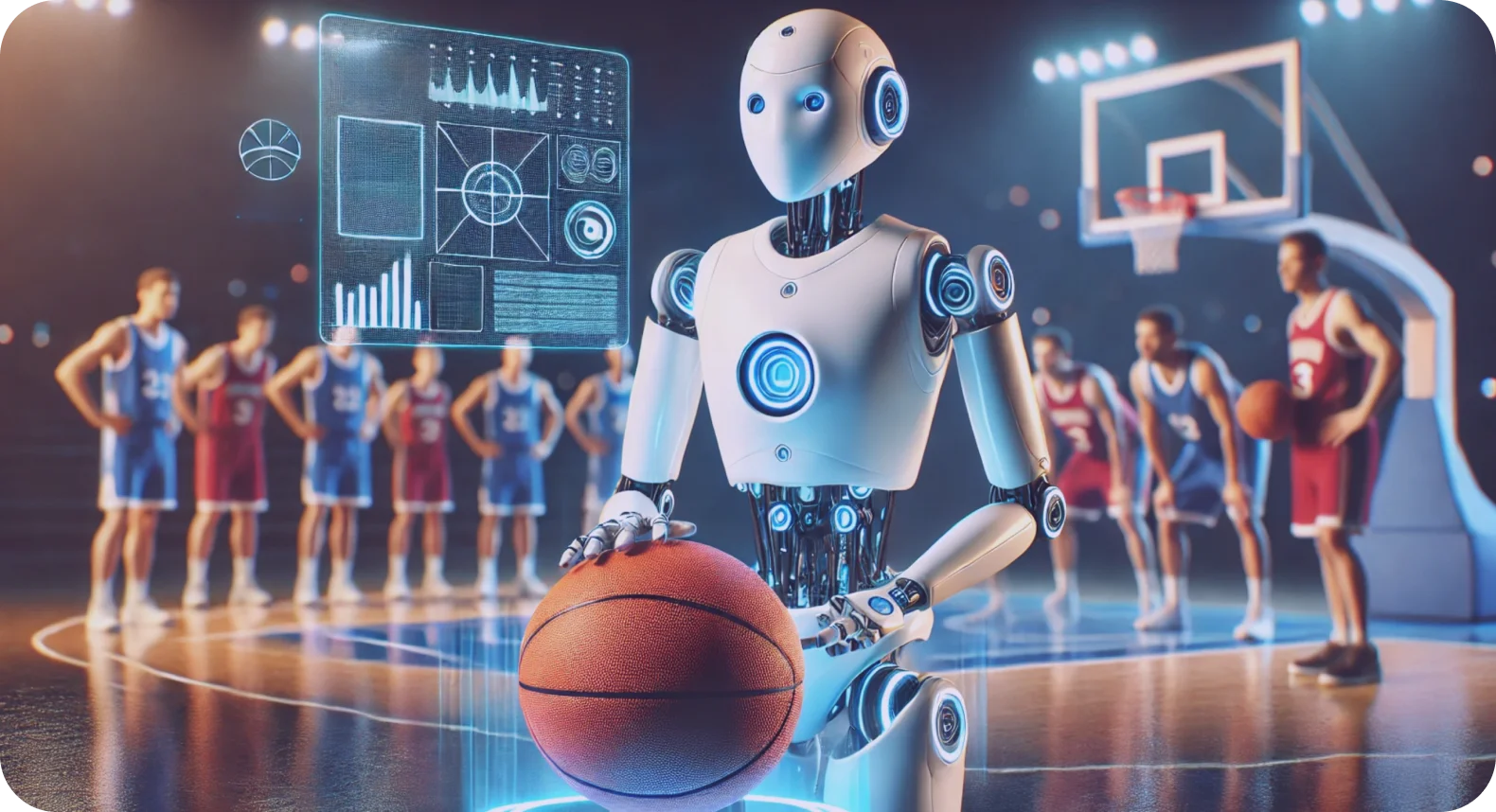
Sports have always been driven by talent, preparation, strategy, and hard work. Today, another force is becoming increasingly important: artificial intelligence.
From analyzing player movements to improving coaching decisions, AI in sports is changing how teams train, compete, broadcast games, and connect with fans.
Modern sports organizations generate huge amounts of data. Player tracking systems, video footage, match statistics, wearable devices, ticketing platforms, social media, and fan behavior all create valuable information. The challenge is turning that information into useful decisions.
That is where AI comes in.
AI systems can process large datasets, recognize patterns, analyze video, generate reports, personalize content, and support faster decision-making.
For example, FIFA’s Football AI Pro combines structured match data, tracking information, video, and specialized AI models to generate tactical insights and reports for football analysts and coaching staff.
In this guide, you will learn:
- What AI in sports means
- How sports organizations use artificial intelligence
- The biggest benefits of sports AI
- Real-world examples
- How AI is changing sports analytics
- How businesses can benefit from sports AI
- The risks and limitations to consider
- What the future of AI in sports may look like
What Is AI in Sports?
AI in sports refers to the use of artificial intelligence, machine learning, computer vision, predictive models, and generative AI to improve sports-related activities.
These technologies can analyze information that would take humans much longer to process.
AI can be used to:
- Track athletes
- Analyze match footage
- Identify tactical patterns
- Support coaching decisions
- Improve performance analysis
- Assist officials
- Generate sports content
- Personalize fan experiences
- Automate business operations
- Analyze audience behavior
The technology is not limited to professional teams.
Sports academies, schools, broadcasters, fitness businesses, content creators, and sports technology startups can also use AI-powered solutions.
How Does AI in Sports Work?
A typical AI sports system follows several steps:
- Collect data from video, sensors, statistics, wearables, or other sources.
- Process the data using machine learning or computer vision.
- Identify patterns in player behavior, performance, or audience activity.
- Generate insights that coaches, analysts, or businesses can understand.
- Support decisions using those insights.
For example, a computer vision system can analyze video to identify players and track their positions on a field. That information can then be used to calculate movement patterns, distances, positioning, and tactical behavior.
FIFA’s electronic performance and tracking systems can combine camera-based tracking and wearable technologies to measure player and ball positions as well as other performance information.
9 Powerful Ways AI in Sports Is Changing the Industry
1. AI Is Transforming Sports Analytics
One of the biggest applications of AI in sports is analytics.
Traditional sports analysis often requires analysts to manually review statistics and hours of video. AI can automate much of this process.
Instead of simply showing that a player completed 85% of their passes, AI systems can potentially identify deeper patterns such as:
- Where the player receives the ball
- How quickly they make decisions
- Which areas of the field they prefer
- How their positioning changes
- How their actions affect team structure
This gives coaches more information when preparing for matches.
FIFA’s Football AI Pro is an example of how generative and hybrid AI can be combined with football data to provide structured tactical insights and analysis.
Why AI Analytics Matters
The main advantage is speed.
A human analyst may need hours to review footage. An AI system can process large amounts of structured information much faster.
That does not mean coaches become unnecessary. Instead, AI gives them more information to work with.
2. Computer Vision Can Track Players Automatically
Computer vision is another major part of AI in sports.
Computer vision allows software to understand information contained in images and video.
In sports, this can include identifying:
- Players
- Referees
- Balls
- Court or field positions
- Body movements
- Player trajectories
- Tactical formations
FIFA is actively researching single-camera skeletal tracking to make player-tracking technology more practical and affordable. The goal is to extract useful skeletal information from standard broadcast footage instead of relying only on expensive multi-camera systems.
This could be particularly valuable for smaller teams and sports organizations.
Why This Matters for Smaller Teams
High-end tracking systems can be expensive.
If AI can extract useful information from ordinary video footage, more academies, schools, amateur clubs, and smaller organizations may gain access to advanced sports analytics.
That creates a major opportunity for sports technology companies.
3. AI Can Support Coaching Decisions
Coaches already use statistics and video analysis to prepare teams.
AI can make this process faster and more detailed.
For example, an AI system could help organize information about:
- Opponent formations
- Passing patterns
- Defensive weaknesses
- Player positioning
- Set-piece strategies
- Match trends
Instead of searching through hundreds of clips manually, an analyst could use an AI-powered system to find relevant moments.
The coach can then review those findings and make the final decision.
AI Should Support Coaches, Not Replace Them
This distinction is important.
Sports involve context, leadership, psychology, communication, and human judgment.
AI can identify patterns, but a coach understands factors that may not appear in a dataset.
The best approach is therefore human + AI, rather than AI replacing human expertise.
4. AI Is Improving Sports Officiating
AI is also being used to support referees and officials.
Football provides a strong example.
FIFA’s semi-automated offside technology combines player tracking, ball data, and artificial intelligence to generate alerts for potential offside situations. The system tracks player body points and ball information at very high frequency.
The purpose is not simply automation.
It is designed to help officials make decisions faster and more consistently.
Newer systems are also exploring 3D player representations to improve tracking and visualization. FIFA has announced AI-powered innovations for the 2026 World Cup, including 3D player avatars and Football AI Pro.
Benefits of AI-Assisted Officiating
AI can potentially help with:
- Faster decisions
- More consistent analysis
- Better replay information
- Improved visualization
- Reduced manual workload
However, human officials remain important because technology can still make mistakes.
5. AI Is Creating Better Fan Experiences
Sports are not only about athletes.
Fans are a huge part of the industry, and AI is changing how they consume sports content.
Generative AI can help organizations create:
- Match summaries
- Personalized highlights
- Player explanations
- Interactive statistics
- Automated commentary
- Social media content
- Personalized fan experiences
For example, IBM has developed AI-powered sports experiences that generate match insights, summaries, and interactive information for fans. Its Wimbledon technology includes AI-powered match analysis and live win-probability experiences.
The result is a more personalized viewing experience.
Instead of every fan receiving exactly the same information, AI can potentially deliver content based on what each person cares about.
6. AI Is Helping Sports Organizations Create Content
Sports organizations produce enormous amounts of content.
Every match can generate:
- Articles
- Social posts
- Video clips
- Match reports
- Statistics
- Interviews
- Newsletters
- Promotional material
AI can help teams and media companies organize and transform this information.
For example, an AI workflow could:
- Collect match statistics.
- Identify important moments.
- Generate a draft match summary.
- Create social media variations.
- Prepare newsletter content.
- Send the content to a human editor.
The editor can then verify the information before publishing.
This approach can significantly reduce repetitive work.
Businesses interested in applying similar automation principles can also explore Thinkingerahub’s guide to AI workflow automation software.
7. AI Can Improve Athlete Performance Analysis
Athlete performance produces a huge amount of data.
Depending on the sport and technology being used, organizations may collect information about:
- Speed
- Distance
- Movement
- Position
- Acceleration
- Training workload
- Technical performance
AI can analyze these datasets to identify trends.
For example, a performance team could compare an athlete’s recent training data with previous sessions and identify changes that deserve further human review.
AI can also analyze video technique.
IBM has highlighted sports AI applications that analyze uploaded video to provide insights into sporting technique, showing how computer vision could make advanced analysis more accessible beyond elite organizations.
Important Consideration
Performance data can be sensitive.
Organizations should have clear rules around:
- Data collection
- Consent
- Storage
- Access
- Privacy
- Data sharing
UEFA’s privacy documentation, for example, explains that performance data can include positioning, speed, distance covered, passes, and other tracking information.
8. AI Is Creating New Sports Business Opportunities
AI in sports is not only a technology story.
It is also a business opportunity.
Sports organizations need solutions for:
- Analytics
- Fan engagement
- Content production
- Marketing
- Ticketing
- Customer support
- Data management
- Video analysis
This creates opportunities for SaaS companies and entrepreneurs.
Potential Sports AI Business Ideas
A startup could build:
- AI video analysis software
- Automated sports content platforms
- AI-powered coaching assistants
- Fan engagement chatbots
- Sports data dashboards
- Athlete performance platforms
- AI transcription tools for sports interviews
This is part of a wider movement toward specialized AI software.
Rather than building one general AI product for everyone, entrepreneurs can create vertical AI solutions for specific industries.
Sports is an excellent example of a vertical market with specialized data and workflows.
9. AI Is Making Sports Broadcasting Smarter
Sports broadcasting produces enormous amounts of information.
AI can help broadcasters turn that information into stories.
For example, an AI system can identify:
- Important match moments
- Player milestones
- Statistical trends
- Turning points
- Historical comparisons
- Relevant player information
IBM’s sports solutions demonstrate how generative AI can transform structured sports data into insights and stories for audiences. Its UFC Insight Engine, for example, uses AI to turn large amounts of sports data into information that can be used by editorial teams and fans.
This can help broadcasters produce more content without requiring a large manual team for every task.
AI in Sports: Key Technologies
Several technologies work together to power modern sports AI.
| Technology | Sports Application | Main Benefit |
|---|---|---|
| Machine Learning | Performance analytics | Finds patterns |
| Computer Vision | Player tracking | Understands video |
| Generative AI | Reports and content | Automates writing |
| Predictive Analytics | Performance forecasting | Supports planning |
| Sensors | Athlete tracking | Collects real-time data |
| Natural Language AI | Data assistants | Makes data easier to use |
| 3D Modeling | Player visualization | Improves analysis |
The strongest systems often combine several of these technologies rather than relying on one AI model.
AI in Sports vs. Traditional Sports Analytics
| Feature | Traditional Analytics | AI-Powered Analytics |
| Data processing | Mostly manual | Highly automated |
| Video analysis | Time-consuming | Faster |
| Pattern detection | Human-led | AI-assisted |
| Reporting | Manual | Can be automated |
| Scale | Limited | Much larger |
| Decision support | Statistical | Statistical + predictive |
| Human involvement | High | Still essential |
AI does not eliminate traditional analytics.
Instead, it expands what analysts can do.
Benefits of AI in Sports
The biggest advantages include:
Faster Analysis
AI can process large amounts of data quickly.
Better Decision Support
Coaches and executives can use data-driven insights to support decisions.
Reduced Manual Work
Automating repetitive analysis can save valuable staff time.
More Personalized Fan Experiences
AI can deliver information based on individual interests.
Improved Content Production
Sports organizations can create reports and digital content more efficiently.
Greater Accessibility
If AI can work from affordable video sources, advanced analysis may become available to smaller organizations.
Limitations and Risks of AI in Sports
AI is powerful, but it is not perfect.
Data Quality Problems
Bad data can produce bad insights.
If tracking information is inaccurate, an AI model may produce misleading conclusions.
Privacy Concerns
Athlete and fan data must be handled responsibly.
Organizations need appropriate policies for collecting, storing, and sharing personal information.
Bias
AI models can reflect weaknesses in the data used to train them.
This means organizations should test systems carefully before relying on their recommendations.
High Implementation Costs
Advanced camera systems, sensors, cloud infrastructure, and specialized software can be expensive.
Overreliance on Technology
AI should support human judgment rather than replace it.
A coach should not blindly follow an AI recommendation simply because it appears statistically convincing.
How to Implement AI in a Sports Business
If you operate a sports organization, media company, academy, or sports-focused business, you do not need to implement everything at once.
Use this step-by-step approach.
Step 1: Identify One Problem
Start with a clear problem.
For example:
“Our analysts spend too much time reviewing match footage.”
That is better than simply saying:
“We need AI.”
Step 2: Identify the Data
Determine what information is available.
This might include:
- Video
- Match statistics
- Customer data
- Social media data
- Training information
- Sales data
Step 3: Choose the Right AI Solution
Select technology based on the problem.
For example:
- Video problem → computer vision
- Reporting problem → generative AI
- Prediction problem → machine learning
- Repetitive workflow → AI automation
Step 4: Start With a Small Pilot
Do not immediately transform the entire organization.
Test one workflow.
Measure:
- Time saved
- Accuracy
- Cost
- User satisfaction
- Business impact
Step 5: Add Human Review
Have qualified people verify important AI-generated outputs.
Step 6: Scale What Works
If the pilot produces measurable benefits, expand it gradually.
Best Practices for Using AI in Sports
Follow these principles for better results:
- Start with a real business or performance problem.
- Use reliable data.
- Keep humans involved in important decisions.
- Test AI outputs before acting on them.
- Protect athlete and customer information.
- Measure ROI.
- Train staff before deploying new systems.
- Review AI performance regularly.
If AI is being introduced into a broader business workflow, the same principles used for business automation can apply: start small, document the workflow, monitor results, and expand gradually.
Common Mistakes to Avoid
Trying to Automate Everything
Not every sports task needs AI.
Choose processes where automation creates measurable value.
Buying Technology Without a Clear Goal
Do not purchase expensive AI software simply because it is popular.
Start with the problem.
Ignoring Human Expertise
AI should enhance analysts, coaches, and staff.
It should not automatically replace their judgment.
Using Poor Data
The quality of an AI system depends heavily on the quality and relevance of its data.
Forgetting Privacy
Athlete and fan information can be sensitive. Establish appropriate data governance before collecting or analyzing it at scale.
Cost Considerations
The cost of AI in sports varies dramatically.
A small organization might start with relatively affordable cloud-based software or AI services.
A professional sports organization may need:
- Multiple cameras
- Tracking systems
- Sensors
- Data infrastructure
- AI software
- Cloud computing
- Specialized analysts
A Practical Budget Strategy
For smaller organizations:
Start with software before hardware.
For example, test whether existing match videos can provide useful insights before investing in a sophisticated stadium-wide tracking system.
FIFA’s ongoing research into single-camera skeletal tracking illustrates the industry’s interest in making advanced tracking more accessible and affordable.
Who Should Use AI in Sports?
AI can benefit many groups.
Professional Sports Teams
Useful for performance analysis, scouting, tactical preparation, and content.
Sports Academies
Can help coaches analyze player development and training footage.
Broadcasters
Useful for automated insights, statistics, summaries, and personalized content.
Sports Media Companies
Can accelerate research and content production.
Sports Technology Startups
AI creates opportunities to build specialized SaaS products.
Digital Marketers
Sports AI can provide new opportunities for content, analytics, personalization, and audience engagement.
Small Sports Businesses
Smaller organizations can start with affordable AI tools for marketing, customer support, administration, and content workflows.
For broader AI business opportunities, readers can also explore Thinkingerahub’s resources on AI startup funding trends and AI regulation and policy.
Pros and Cons of AI in Sports
Pros
- Faster data analysis
- More efficient workflows
- Better performance insights
- Improved fan engagement
- Automated content creation
- Better video analysis
- More scalable sports operations
- New SaaS opportunities
Cons
- Implementation costs
- Data privacy concerns
- Potential inaccuracies
- AI bias
- Technical complexity
- Dependence on quality data
- Risk of overreliance on automation
The Future of AI in Sports
The future of AI in sports will likely involve deeper integration between data, video, sensors, and generative AI.
Instead of having separate systems for statistics, video, and reports, organizations may increasingly use unified AI platforms.
A coach could potentially ask a natural-language question such as:
“Show me our strongest attacking patterns from the last five matches.”
The system could then search relevant data, analyze video, generate visualizations, and produce a report.
FIFA’s Football AI Pro already points toward this direction by combining structured match data, tracking information, video, and AI-generated insights in one analytical environment.
AI may also become more accessible to smaller organizations.
Research into extracting player tracking information from standard broadcast footage is one example of how computer vision could reduce dependence on expensive specialized infrastructure.
This could create a more data-driven sports ecosystem where advanced analysis is not limited to the wealthiest teams.
Final Verdict
AI in sports is no longer just a futuristic concept. It is already being used across performance analysis, coaching, officiating, broadcasting, fan engagement, and sports business.
The biggest advantage of AI is its ability to transform large amounts of information into useful insights quickly.
However, successful adoption requires more than buying an AI tool.
Sports organizations need:
- Good data
- Clear goals
- Human oversight
- Strong privacy practices
- Reliable technology
- Measurable results
For professional teams, AI can provide a competitive advantage.
For smaller organizations, affordable AI software can reduce manual work and make advanced analysis more accessible.
For entrepreneurs and SaaS companies, sports AI presents a growing market for specialized tools and services.
The best strategy is simple: start with one meaningful problem, test an AI solution, measure the results, and scale what works.
Want to explore how artificial intelligence can improve your own workflows?
Start by identifying one repetitive task in your sports, marketing, content, or business operation. Then test an AI-powered solution and measure the time, cost, or performance improvements.
For more practical AI and automation strategies, explore the other guides available on Thinking Era Hub, including AI workflow automation software and other resources covering AI tools, digital marketing, and emerging technology.
6. FAQ Section
What is AI in sports?
AI in sports is the use of artificial intelligence, machine learning, computer vision, predictive analytics, and generative AI to improve athlete performance, coaching, officiating, broadcasting, fan engagement, and sports business operations.
How is AI used in sports?
AI is used to analyze player performance, track athletes, study match footage, support coaching decisions, assist officials, create sports content, personalize fan experiences, and automate business processes.
How does AI improve sports performance?
AI can analyze large amounts of performance and tracking data to identify patterns in movement, positioning, workload, and technique. Coaches can use these insights to support training and tactical decisions.
Can AI replace sports coaches?
No. AI can support coaches by processing data and identifying patterns, but human coaches provide leadership, context, communication, and judgment that AI cannot fully replace.
How is AI used in football?
AI is used in football for player tracking, tactical analysis, performance analysis, content creation, and officiating support. FIFA’s Football AI Pro and semi-automated offside technology are examples of AI-powered football applications.
What is computer vision in sports?
Computer vision is AI technology that allows software to analyze images and video. In sports, it can identify and track players, balls, movements, positions, and other events.
Is AI in sports expensive?
The cost depends on the technology. Basic cloud-based AI software can be relatively affordable, while advanced professional systems involving cameras, sensors, tracking infrastructure, and custom analytics can require significant investment.
What is the future of AI in sports?
The future will likely involve more real-time analytics, computer vision, generative AI assistants, automated content, personalized fan experiences, and integrated systems combining video, tracking, statistics, and other sports data.